
You have chosen the hoodie. The fabric, weight, fit and labels are settled, and the last decision before production is how your artwork gets onto the garment. For most clothing brands that comes down to DTF vs screen printing, the two methods that cover the bulk of hoodie decoration in the US market. The choice is not cosmetic. It sets your setup cost, your per-unit price, how the print feels on heavy fleece, and how closely your reorder matches this run.
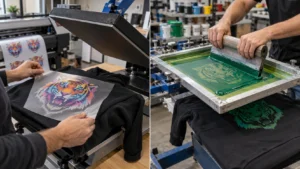
The practical difference in DTF vs screen printing is simpler than most guides make it. Screen printing pushes ink through a separate stencil for each color, then cures it under heat so it bonds into the fabric. That means a real setup step and a cost tied to how many colors your design uses. DTF, or direct-to-film, prints the whole design onto a film in full color, bonds a powder adhesive to it, and heat presses it onto the hoodie as one transfer. There are no screens and no per-color setup, so a ten-color graphic costs the same to apply as a single-color one.
That one distinction drives every business variable that follows. Order quantity decides whether screen setup is worth spreading out. Color count and artwork complexity decide whether screens are practical at all. Fabric matters because a hoodie is rarely plain cotton, and the blend changes how each method bonds. Then come hand feel, wash durability, lead time and the unit economics a brand has to defend to its own margins. None of these point the same way for every order, so the useful answer is a framework, not a single winner.
Here is the early takeaway. For a short run, a full-color or photographic design, or a polyester-heavy performance fleece, DTF usually makes more sense. For a larger run of a bold design in a handful of solid colors on cotton-rich fleece, screen printing usually wins on cost and long-term wear. The genuinely close cases sit in the middle, a few hundred units with two or three colors, and there the DTF vs screen printing call turns on details specific to your hoodie rather than a rule of thumb.
How DTF vs Screen Printing Works on a Hoodie
Take the two halves of DTF vs screen printing in turn. Screen printing is a bonded-ink process. A mesh screen is burned with your design, one screen per color, and ink is pulled across it so it passes only where the design is open. Most apparel work uses plastisol ink, cured with heat so it fuses to the fabric surface and top fibers. The result is a thin, flexible layer of ink that sits on and slightly into the garment. Because each color needs its own screen and registration, the setup effort is the same whether you print fifty hoodies or five hundred.
DTF reverses the order. Your design is printed in full color onto a coated film, a hot-melt adhesive powder is applied and cured, and the transfer is heat pressed onto the hoodie, commonly around 160 to 170 degrees Celsius for a short dwell, with no garment pretreatment. The bond is mechanical, so the transfer holds to the surface of the fabric rather than soaking into the fibers. That is why DTF handles unlimited colors and fine detail at no extra cost, and why the print reads as a distinct layer on top of the fleece.
What Changes When the Garment Is a Hoodie, Not a Tee
Hoodie fabric is the variable that catches brands out, because most printing advice is written for flat cotton tees. Hoodies are heavier, often brushed, and frequently blended. A brushed fleece has a raised pile, so a print sits on a textured surface rather than a smooth one, and fine linework or small text can lose crispness on a high-pile face. Poly-rich performance fleece adds its own issue: high heat and pressure can scorch or glaze synthetic fabric, so press temperatures have to be controlled, and plastisol needs correct curing to limit dye migration, where a polyester dye bleeds into the ink.
Placement is the second hoodie-specific problem. A front kangaroo pocket, the seam where it attaches, zippers on a full-zip, and the hood itself all interrupt the flat print area. A large front graphic often has to sit above the pocket or split around it, while a back print has more usable space. Both methods need a smooth, supported panel to print or press cleanly, so placement should be agreed against the actual style before production. On thick heavyweight fleece, curing and press dwell matter more, because heat has to reach the ink or adhesive through more material.
Print Quality, Color and Artwork Complexity
This is where the DTF vs screen printing gap is widest. Screen printing produces solid, punchy spot colors with excellent opacity, and on brushed fleece a bold plastisol print has strong color payoff. Its limit is the screen count: gradients, photographic images and many-colored artwork get difficult or uneconomic, because each color is another screen. DTF prints anything a file can hold, full color, gradients, fine detail and photographic effects in one pass, and it carries its own white underbase so it shows cleanly on black or heather hoodies without a separate step. If your brand identity depends on a complex or photographic graphic, DTF removes the constraint screen printing imposes.
Hand Feel and Finish
Feel is where DTF vs screen printing separates a premium hoodie from a promotional one, and the two land differently in the hand. A screen print sits as a thin, flexible film on the surface, and on a large solid area you can feel the ink. DTF has a slightly raised, film-like hand over the printed area, more noticeable on big prints than small ones. On brushed fleece both finishes sit on top of the pile rather than sinking in. For a small chest logo the difference is minor. For a large front-and-back graphic, press a sample of both on your actual fabric and decide with your hands. For compact logos where a raised, stitched look is the selling point, embroidery is worth comparing alongside either print method.
Durability and Wash Performance
Durability is closer than the marketing on either side suggests. Applied and cured correctly, both methods commonly survive fifty or more home washes without meaningful cracking or fading. A well-cured plastisol screen print on cotton-rich fleece holds a slight edge at the extreme high end of wash cycles, which matters most for garments put through frequent or industrial laundering. DTF performs as well or better on polyester and blended fleece, where a rigid screen print is more prone to cracking as the fabric stretches. The failure modes differ: screen prints fail from under-curing or from cracking on heavy stretch, while DTF fails from edge peel when the adhesive powder is under-cured or the press runs too cold. Both trace back to process control, which is why curing discipline decides real-world durability more than the choice of DTF vs screen printing does.
The DTF vs Screen Printing Cost Math
The clearest way to settle DTF vs screen printing is to run the numbers on your order. Screen printing carries a setup cost per color, so a four-color design starts with four screens to burn and register before a single hoodie prints. That cost is fixed, so it barely registers across a large run and dominates a small one. Per-unit ink cost is low, which is why screen printing gets cheaper the more you print and reaches its lowest unit price on large, simple-color orders. DTF has little to no setup and a fairly flat cost per transfer regardless of color count, so it wins at low quantities, on many-colored art, and where every piece differs, such as names and numbers. The crossover, where screen printing overtakes DTF on unit cost, generally sits in the hundreds of units and moves higher as colors rise, because more colors mean more screens to absorb. The real question in DTF vs screen printing is your minimum economically viable quantity: below it, DTF protects your margin, and above it, screen printing does.