
Sublimation printing puts artwork into a rash guard instead of on top of it. Under heat and pressure, solid dye turns straight to a gas, diffuses into the polyester fibers of the fabric, and re-solidifies inside them as the fabric cools. The color becomes part of the textile, which is why a well-produced sublimated rash guard can be stretched hard in a scramble without the print cracking, peeling or lifting at the edges. For a brand developing performance apparel, that single property is the reason sublimation printing is the default decoration method on high-stretch grappling and surf product.
Rash guards suit this method because of what they are made from. These are close-fitting knits built on polyester blended with spandex, and sublimation dye bonds specifically to polyester. The higher the polyester content, the more completely the dye takes, so a typical 80/20 or 85/15 polyester-spandex knit prints cleanly and holds color through repeated washing. Because the artwork lives in the fiber rather than sitting on the surface as a film, it does not add stiffness, block airflow or resist the four-way stretch the garment depends on. If you want the fundamentals of the garment first, our guide to how rash guards are constructed and used covers fabric, fit and seams, and the way Best Gym Wears approaches performance product carries through to how each piece is printed.
The result on the finished garment is decided by variables a brand controls, not by the method alone. Fabric composition sets how saturated the color can get. Artwork format and resolution set how sharp it stays at garment scale. Panel layout and seam registration decide whether a design lines up across a side seam or a raglan sleeve. Heat, pressure and dwell time set whether the transfer is complete without scorching the fabric. Sampling and lot control decide whether run two matches run one. These are the decisions worked through during custom rash guard manufacturing, and getting them specified early is most of the job.
Here is the practical takeaway before the detail. Sublimation printing is the right call when the fabric is high-polyester, the artwork is full-color or edge-to-edge, and the garment has to stretch and wash without the print degrading. Its real limits are that it needs a white or light base to show true color, it depends on polyester content to bond, and it matches target colors closely rather than exactly. Specify the garment and the print together, because the fabric you choose changes the result the print can deliver. Reviewing the performance apparel fabric options alongside your artwork is the most useful first step a brand can take.
How Sublimation Printing Works on Rash Guard Fabric
The process runs in two stages. First, the design is printed in reverse onto transfer paper using disperse dye inks. Then the paper is laid against the fabric and passed through a heat press or a roller calendar, commonly in the region of 180 to 205 degrees Celsius, with steady pressure for a set dwell. At that temperature the dye sublimates, moving from solid to gas without becoming liquid, while the polyester softens and its polymer chains open enough for the gas to diffuse in. When the fabric cools, the dye is locked inside the fiber.
That mechanism explains the properties brands care about. Because the color is diffused into the polymer rather than bonded to the surface as a coating, there is almost no hand feel, the knit keeps its breathability, and the print stretches and recovers with the fabric. It also explains the constraints covered below, since anything that weakens the dye-to-polyester relationship, whether low polyester content, a dark base or an imprecise heat recipe, shows up directly in the finished rash guard.
Why Polyester and Spandex Content Change the Result
Polyester percentage is the first thing that decides print quality. Disperse dyes are formulated to bond with polyester, so a high-polyester knit produces deeper, more saturated, more wash-stable color. Spandex, the elastane that gives a rash guard its stretch and recovery, takes almost no dye, which is why the fabric is engineered so the polyester carries the image while the spandex does the mechanical work. Standard rash guard fabrics in the 80/20 to 85/15 polyester-spandex range are well suited to sublimation printing for exactly this reason.
Other fibers behave differently and should be flagged at the fabric stage. Nylon-spandex, used in some premium and swim-leaning rash guards, does not accept disperse dye the way polyester does, so results are less predictable and often softer in color, and it needs a process suited to the fiber rather than a default polyester recipe. Cotton is not a sublimation printing fabric at all, because there is no polymer for the dye to diffuse into, so any color would sit loosely and wash out. This is a practical reason cotton rarely appears in serious rash guard construction. Fabric weight and surface also shift the outcome: the same file reads brighter on a smooth face than on a matte or brushed one, and a very light, low-GSM knit can look less opaque when stretched over the body, which is a fabric-opacity issue rather than a fault in the print.
The White Base Rule and Color Behavior
Sublimation lays down translucent dye and has no white ink, so it can only add color darker than the base fabric and cannot lighten it. That is why white and light fabrics are standard in sublimation printing: they let the full color range read accurately. A design can include dark and black areas on a white base without difficulty. Trying to run the reverse, printing a light or bright design onto a dark base, either fails or forces workarounds, because the dye cannot overpower the fabric color underneath.
Color matching deserves an honest explanation, since it is where expectations and production most often diverge. Sublimation is a CMYK process managed with ICC color profiles built for a specific ink, paper and fabric combination. Within that system, colors are matched closely to a reference, but a Pantone value is a target rather than a guarantee. The same file can read differently on a matte knit than on smooth nylon, and bright fluorescents and deep, dense blacks are the hardest to hit consistently. The only reliable check is a physical sample on the actual production fabric, approved before bulk. Treat a screen or a printed swatch on paper as an indication, not a contract.
Artwork Requirements for Clean Results
Artwork should be supplied at production scale, not scaled up later. Vector files are ideal for logos, type, rank bars and hard-edged graphics because they stay crisp at any size. Photographic and painterly artwork has to be high-resolution raster, large enough to print at full garment dimensions without softening. Sublimation printing handles gradients, photographic imagery and unlimited colors in a single pass with no per-color charge, which is a genuine advantage over surface methods, but very fine lines and small text can lose a little definition on a textured or stretched knit, so detail that must stay legible should be sized with that in mind. For all-over designs, the layout is built to the panel shapes and grading so the artwork sits correctly once the garment is cut and sewn.
Full Sublimation and Cut-and-Sew Sublimation
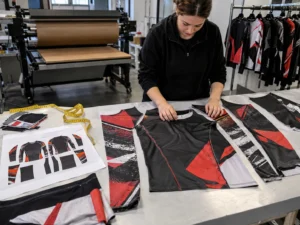
There are two production routes, and the difference matters most on rash guards with seams running through the design. Full sublimation prints continuous, edge-to-edge artwork and suits gradients, photographic panels and all-over patterns. Cut-and-sew sublimation prints each panel separately before the garment is assembled, which is how a manufacturer holds seam-line registration on block colors, stripes and geometric designs that would otherwise drift where two panels meet. The service side of that choice sits with the custom apparel printing methods a factory runs, but the design decision belongs to the brand: if your artwork depends on sharp alignment across a side seam or a raglan shoulder, plan for cut-and-sew from the start.
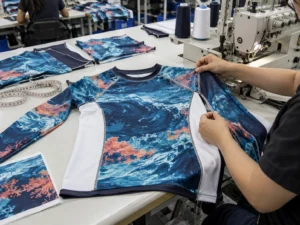
Two seam realities are worth building into the artwork. A four-way stretch fabric distorts the print slightly as it is pulled over the body, so a pattern that relies on perfect geometry will read differently under tension than flat on a table. And artwork that crosses a seam will only align as closely as the panels are cut and matched, which is a reason to keep critical logos and rank markings clear of seam lines where possible.
Durability, Stretch and Hand Feel
The durability argument for sublimation printing on rash guards is straightforward. Because the dye is inside the fiber, it does not crack when the fabric stretches or peel at the edges the way a heavy surface print eventually can on a high-stretch knit, and there is effectively no added thickness or stiffness. Wash performance is strong when the fabric is high-polyester and the print recipe is correct, though no print is immune to fading over a long enough life, and heavy UV exposure, hot washing and low-quality dye all shorten color life. Breathability and moisture movement are preserved because nothing coats the surface of the knit. One production caution sits underneath all of this: spandex is heat-sensitive, and excessive press temperature or dwell can damage the elastane and hurt recovery, so the heat recipe has to protect the stretch as well as set the dye.
Common Production Problems to Watch For
Most sublimation printing faults trace back to the heat recipe, the paper or the fabric rather than the artwork. Under-transfer from too little heat, time or pressure leaves color pale and washed out. Too much heat can scorch or yellow the fabric and soften fine detail. Ghosting happens when the transfer paper shifts during pressing and leaves a faint double image. Banding and color drift show up when files, profiles or dye lots are inconsistent between runs. On all-over designs, registration can drift across a large print, and on darker or blended fabrics color can read muddy. Uneven pressure around seams, collars and any raised area produces patchy transfer in those exact spots. None of these are inherent to the method. They are process-control issues, which is why the sample-approval and in-line checks below exist.
Sublimation Printing vs Other Methods for Rash Guards
Sublimation is not the only way to decorate a rash guard, but sublimation printing is usually the strongest fit for high-stretch, full-color work. The comparison below frames it against the two surface methods brands most often weigh.