
Activewear manufacturing cost in 2026 starts with a factory price that published supplier figures place at about $4 to $35 per piece, but that number is rarely what a brand ends up paying. Fabric, construction, decoration, order quantity, sampling, freight and import duty all sit between the quote and the true cost of a sellable unit.
This guide is for brand owners, private label startups and wholesale buyers planning a bulk run. It explains what moves activewear manufacturing cost for each garment, how quantity and sampling change the unit cost, and how to work out landed cost for a US or European order, with every assumption shown.
It is written by the team at Best Gym Wears, a gym wear and activewear manufacturer in Sialkot, Pakistan. We quote each order against its specification rather than publishing a price list, so the figures below come from published supplier pricing, current trade rules and a clearly labeled worked example, not from our own price sheet.
How Much Does It Cost to Manufacture Activewear in 2026?
Published 2026 supplier figures put the factory price of custom activewear at roughly $4 to $35 per piece before freight and duty. Basic tops, bras and shorts sit at the low end; panelled leggings, hoodies and sublimated rash guards sit higher. For US buyers, duty on the synthetic leggings, T-shirts and sweatshirts we checked currently adds 38.2 to 42 percent of the declared value.
No single activewear manufacturing cost covers every product, because each quote prices a different combination of fabric, labor, decoration, quantity and delivery terms. The table below shows what manufacturers and sourcing platforms published in 2026, with the basis each figure was given on.
| Product and Basis | Published Figure | Source Type |
|---|---|---|
| Basic leggings, 100 pcs, solid color | $10 to $14 factory price | Activewear factory guide, Aug 2026 |
| Basic leggings, 300 pcs | $6 to $9 factory price | Same guide |
| Leggings and sports bras, 100 to 300 pcs | $6 to $12 legging, $4 to $8 bra, ex-works | Activewear supplier guide, 2026 |
| Hooded sweatshirt, 400 GSM, 500 pcs | $10 to $20 FOB, Asian origins | Alibaba.com seller guide, 2026 |
| Compression leggings, few hundred pcs, landed | $12 to $16 incl. freight and duty | Sialkot manufacturer guide, Jun 2026 |
| Custom gym wear in general | $8 to $35, excl. shipping and duty | Functional textile supplier |
These are advertised figures from different countries, quantities and dates. They show the spread of the market, not an average, and none of them is a Best Gym Wears price.
What Drives Activewear Manufacturing Cost
Fabric Composition, GSM and Consumption
Fabric is usually the largest share of activewear manufacturing cost. Supplier breakdowns commonly put it at 40 to 60 percent of the total. Three choices move it: composition, because nylon-spandex blends cost more than polyester-spandex; weight, because a higher GSM fabric uses more material per piece; and color, because custom-dyed shades and printed fabrics can trigger mill minimums.
Consumption matters as much as the price per meter. A hood and pouch pocket add fabric to a sweatshirt, and one 2026 sourcing guide puts the hooded version at $3 to $8 more per unit than a crewneck. Our activewear fabric guide compares the knits most often used for training tops, leggings and fleece.
Construction and Stitching
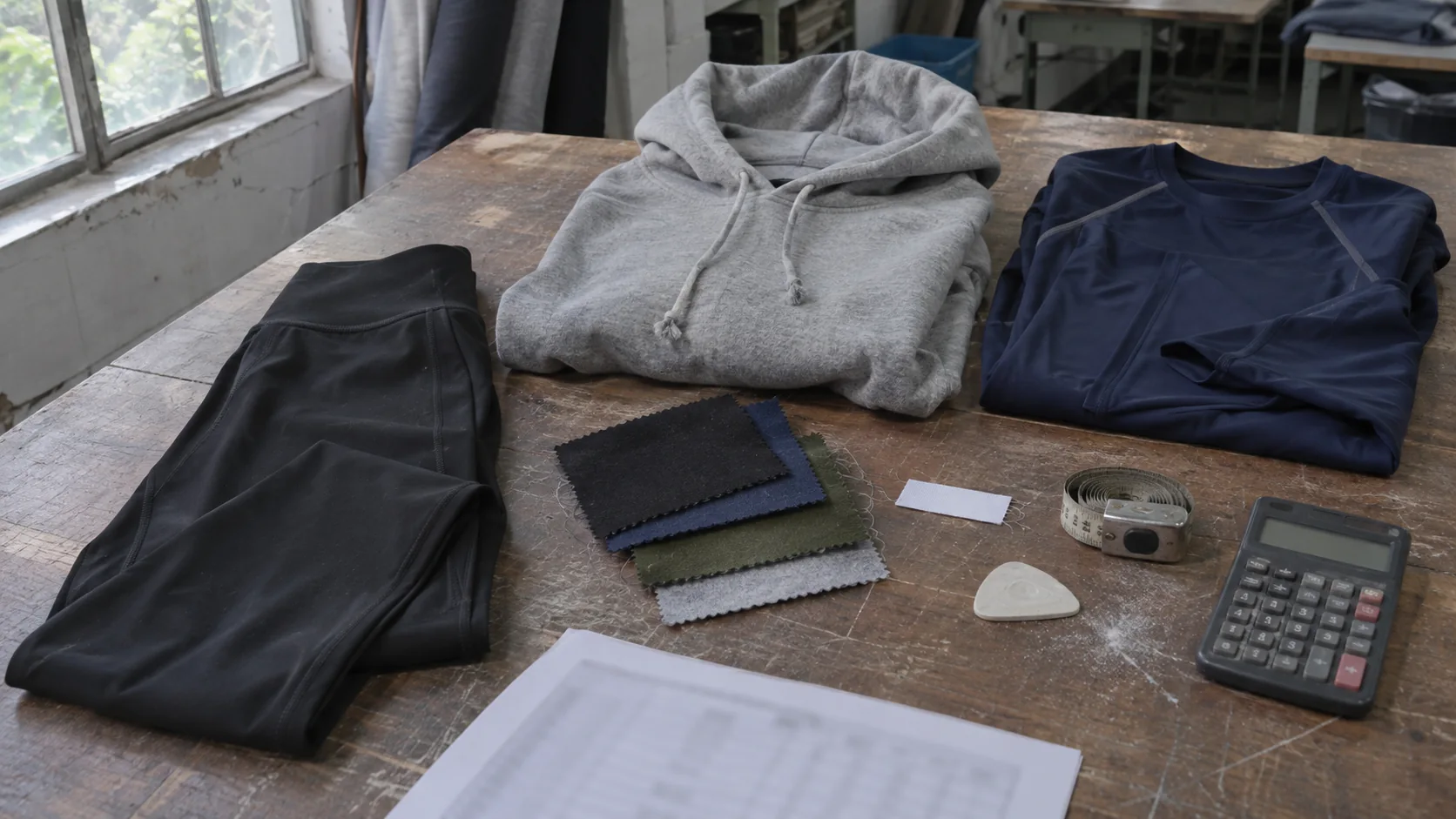
Labor rises with every operation. Flatlock seams need specialist machines and run slower than overlock seams, while gussets, bonded or multi-panel waistbands, pockets and zips each add sewing time. One Sialkot manufacturer publishes cut, make and trim (CMT) labor of roughly $2 to $6 per piece for standard activewear in Pakistan, higher for technical builds. Ask any supplier to break CMT down by operation so you can see which design detail costs what.
Decoration and Branding
Decoration has two parts: setup and per-piece cost. Screen printing is inexpensive per piece on volume but needs a screen for every color, with one 2026 guide citing $20 to $150 setup per color. Sublimation needs a polyester-rich base, though an all-over print costs the same however many colors it uses. Embroidery is priced mainly by stitch count. Woven labels, hang tags and polybags are small per piece, typically cents to about a dollar each, yet together they can add more than a dollar to every garment.
Quality Checks and Packing
In-line and final inspection, individual polybags, barcode labels and marketplace prep all take labor, so retail-ready packing costs more than bulk packing by size. State the packing format before you request a price.
Activewear Manufacturing Cost by Product Type
Each product has its own pressure points. Use this table to see where the money goes before you compare quotes.
| Product | What Raises the Cost | Confirm on the Quote |
|---|---|---|
| Gym T-shirts and tank tops | Fabric weight, print colors, binding | Fabric GSM and print method |
| Leggings | Nylon blends, panels, gusset, flatlock seams | Composition and an opacity test on the sample |
| Compression rash guards | Sublimation layouts, stretch fabric, flatlock seams | Whether print setup is charged per design |
| Gym hoodies | Fleece weight, hood and pocket fabric, zips, embroidery | GSM, and stocked versus dyed-to-order fleece |
| Training shorts | Liners, pockets, waistband elastic | Liner fabric and drawcord specification |
| Muay Thai shorts | Satin, tall waistband, embroidered lettering | Stitch count and number of d |
How Order Quantity Changes the Unit Cost
Every style carries fixed costs that do not grow with the order: pattern and grading work, sampling, print screens or embroidery files, and customs entry fees. Spreading those costs is the main reason activewear manufacturing cost per piece falls as a run grows. The arithmetic below uses an illustrative $300 of fixed costs per style.
| Order Quantity per Style | Fixed Cost per Piece | What It Means |
|---|---|---|
| 20 pieces | $15.00 | One-off costs can rival the garment price |
| 50 pieces | $6.00 | Still a large share of the unit cost |
| 100 pieces | $3.00 | Fixed costs become manageable |
| 300 pieces | $1.00 | Fixed costs fade into the margin |
| 500 pieces | $0.60 | The garment price dominates |
So is 100 pieces cheaper per unit than 50? Almost always, because the same setup is shared by twice as many garments, and fabric buying and line efficiency may improve the variable price as well. A larger run also ties up more cash and raises the risk of unsold sizes. Ask for tiered quotes at two or three quantities rather than assuming a discount.
Best Gym Wears starts at 20 pieces per style, split across sizes, which suits brands testing a new range before committing to larger runs. Our guide to low MOQ clothing manufacturing explains how minimums are counted per style, color and size.
Sampling and Development Costs
Sampling is the part of activewear manufacturing cost spent before production starts, so it rarely appears in a per-piece quote. It covers pattern making, a first prototype, revision rounds, a pre-production sample and courier charges in both directions. One Sialkot manufacturer publishes $30 to $80 per sample and $30 to $60 per courier leg, and suggests budgeting $500 to $800 per product across all rounds. Custom fabric sourcing or lab dips add to that.
The fastest way to cut sampling cost is to reduce revision rounds. A complete specification does that, and our step-by-step guide on how to make a tech pack shows what to include. At Best Gym Wears, sample cost and timing depend on the design and are confirmed with your quotation.
Get a Custom Activewear Manufacturing Quote. If you already know the product, quantity and decoration method, send your brief through our quote form for product-specific pricing.
Factory Quote vs. Landed Cost
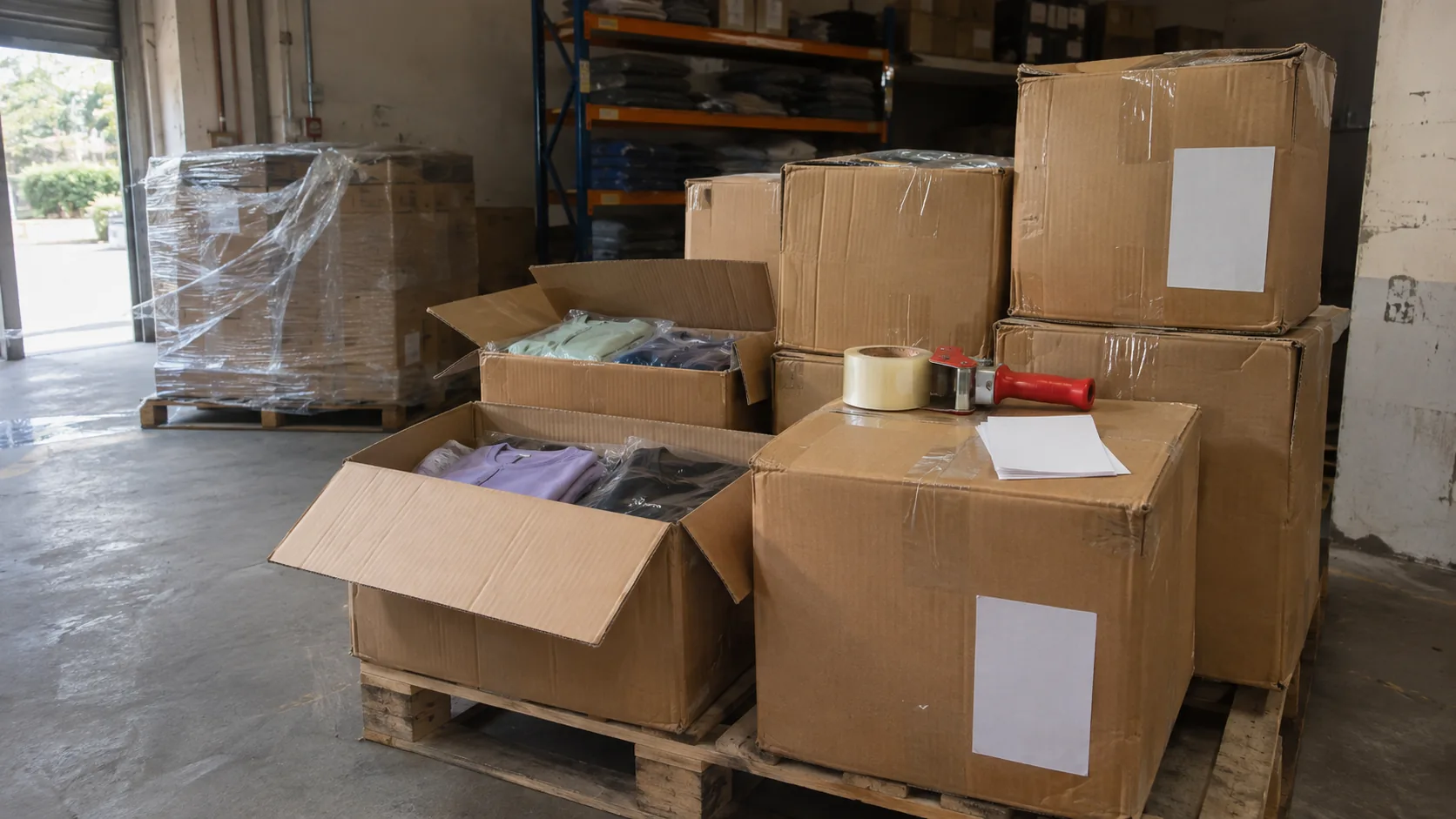
A factory quote states where its responsibility ends. EXW (ex works) means you collect from the factory. FOB applies to sea freight and covers delivery onto the vessel at the port of export; for air shipments the matching term is FCA. DDP means the supplier delivers with import duties paid. Landed cost is everything you pay until the goods reach your warehouse, whichever term the quote uses.
US Import Duty on Activewear in November 2026
US duty on apparel is built in layers:
- Base (MFN) duty by HTS code. Women's synthetic knit trousers, the code for most women's leggings (6104.63.20), carry 28.2 percent. Men's synthetic knit T-shirts (6109.90.10) and synthetic sweatshirts and hoodies (6110.30.30) carry 32 percent. Check your exact code in the USITC Harmonized Tariff Schedule.
- Section 301 duty. Since July 24, 2026, goods of Pakistan carry an additional 10 percent. It replaced a temporary 10 percent Section 122 surcharge, which followed the Supreme Court ruling of February 20, 2026 that ended the earlier IEEPA reciprocal tariffs.
- Merchandise Processing Fee. 0.3464 percent of value, with a minimum of $34.58 and maximum of $670.86 per formal entry from October 1, 2026.
- No de minimis shortcut. Duty-free treatment for low-value commercial shipments was suspended on August 29, 2025, and the suspension remains in place.
Because duty is charged on the declared value, every extra dollar of factory price on a pair of leggings adds about 38 cents of US duty at today's combined rate. US tariffs on apparel changed several times in 2025 and 2026, so confirm the rate with a licensed customs broker before you order.
Import Duty for European Buyers
The EU applies third-country duty of up to 12 percent on most knitted garments. Pakistan's GSP+ status gives duty-free access on about 66 percent of EU tariff lines, and around 89 percent of its textile and apparel exports enter the EU duty-free. Claiming that preference requires valid origin documentation from the exporter, and import VAT still applies. Pakistan's GSP+ status is under EU review ahead of its renewal beyond 2027, so check it when you plan a European order.
Worked Example: Landed Cost of 100 Leggings
The formula is simple:
Estimated landed unit cost = (production + allocated development + packaging + freight + duties + other charges) ÷ sellable units
The example below is hypothetical. The factory price, sampling, freight and broker figures are assumptions chosen to sit inside published ranges; they are not a Best Gym Wears quotation. The duty rates are the US rates described above.
| Cost Line | Assumption | Order Total |
|---|---|---|
| Production, packed (fabric, CMT, trims, labels, polybag) | $10.00 × 100 pcs, FCA Sialkot | $1,000.00 |
| Sampling, two rounds | $90 per round incl. courier | $180.00 |
| Air freight to the US | $2.00 per piece | $200.00 |
| MFN duty, HTS 6104.63.20 | 28.2% of $1,000 | $282.00 |
| Section 301 duty | 10% of $1,000 | $100.00 |
| Customs entry, broker and MPF | Flat assumption | $120.00 |
| Landed cost | 100 sellable units | $1,882.00 ($18.82 each) |
In this example the quoted activewear manufacturing cost is just over half of the landed cost, and US duties alone add $3.82 per pair. Ship the same order to Germany with a valid GSP+ origin statement and the duty line falls to zero, giving about $15.00 per pair before import VAT. Without GSP+, a 12 percent EU duty would add about $144, because EU duty is calculated on a value that includes freight to the EU border.
If two pieces are kept back for photography or rejected at inspection, divide by 98 instead of 100.
How to Compare Manufacturing Quotes Fairly
Before comparing activewear manufacturing cost across suppliers, line the quotes up on the same basis:
- Same delivery term. An EXW price and a DDP price are not comparable.
- Fabric included or not. A CMT quote excludes fabric, usually the largest cost.
- Fabric specified in writing. Composition and GSM should match on the sample and in bulk.
- Setup and sampling listed separately. Check whether sample fees are credited against bulk.
- Branding and packing included. Labels, hang tags and polybags are often extra lines.
- Payment terms. Deposit and balance timing affect your cash flow as much as price.
What to Send for an Accurate Activewear Manufacturing Quote
A complete brief removes the assumptions that inflate a price. Send:
- Product type, with a tech pack, sketch or reference garment
- Quantity per style and the size split
- Fabric composition and GSM, or the hand feel you want
- Decoration method and logo files
- Labels, hang tags and packing format
- Destination country and preferred delivery term
- Target delivery date
Best Gym Wears reviews the brief and replies with unit pricing and a production timeline for that order. The stages of our production process show where each approval happens, and US buyers can see how we handle sampling and shipping on our fitness apparel manufacturing page for USA brands.
Activewear Manufacturing Cost FAQs
How much does it cost to manufacture activewear?
Published 2026 supplier figures range from about $4 to $35 per piece at the factory. Landed cost is higher once sampling, freight and duty are added: in the worked example, $10 leggings land in the US at about $18.82 each.
Is manufacturing 100 pieces cheaper per unit than 50?
Usually, yes. Fixed costs such as patterns, sampling and print setup are shared by twice as many pieces. The total outlay and the risk of unsold sizes are higher, so compare tiered quotes before deciding.
How much does sampling cost?
Published figures from Pakistani manufacturers run about $30 to $80 per sample plus courier charges, or $500 to $800 per product across all rounds. At Best Gym Wears, sample cost is confirmed with the quotation.
Does custom printing increase activewear manufacturing cost?
Yes. Screen printing adds setup for every color, embroidery is priced by stitch count, and sublimation needs a polyester-rich fabric. The effect per piece is largest on small runs, where setup is spread over fewer garments.
Do US buyers pay import duty on activewear made in Pakistan?
Yes. As of November 2026, US imports from Pakistan pay the base HTS duty, such as 28.2 percent for most women's synthetic leggings, plus a 10 percent Section 301 duty, plus customs processing fees. Duty-free de minimis entry is no longer available for commercial shipments.
What is the minimum order at Best Gym Wears?
The minimum is 20 pieces per style. Sizes can be split within those 20, and standard colors can be mixed where production allows.
Plan Your Budget on Landed Cost
Activewear manufacturing cost is set by three decisions: the specification, the quantity per style and the route to market. Fix the fabric, construction and branding first, then compare quotes on the same delivery term and work out the landed cost per sellable unit before you set a retail price.
Get a Custom Activewear Manufacturing Quote. Contact Best Gym Wears with your product, quantities per size, decoration method and destination country, and we will reply with unit pricing, a sampling plan and a production timeline.