

Uncategorized

BJJ Gi Size Chart: How A0 to A6 Sizing and Fit Really Work

A BJJ Gi size chart matches your height and weight to a size code, usually A0 to A6 for adults, with higher numbers for larger bodies. Those codes are not standardized: an A2 from one brand can cover different heights, weights and garment measurements than an A2 from another. Treat height and weight as the starting point, then check the jacket and pant measurements and the fit you want before you order.

This guide explains what the size codes and letters mean, how to read a BJJ Gi size chart properly, how a Gi should fit for training and for competition, what to do between sizes, and how BJJ brands can build a size system that customers trust.

BJJ Gi Size Chart Quick Reference

Use this table to understand the system in about a minute. It explains what each label usually signals; exact heights, weights and measurements always come from the brand's own BJJ Gi size chart.
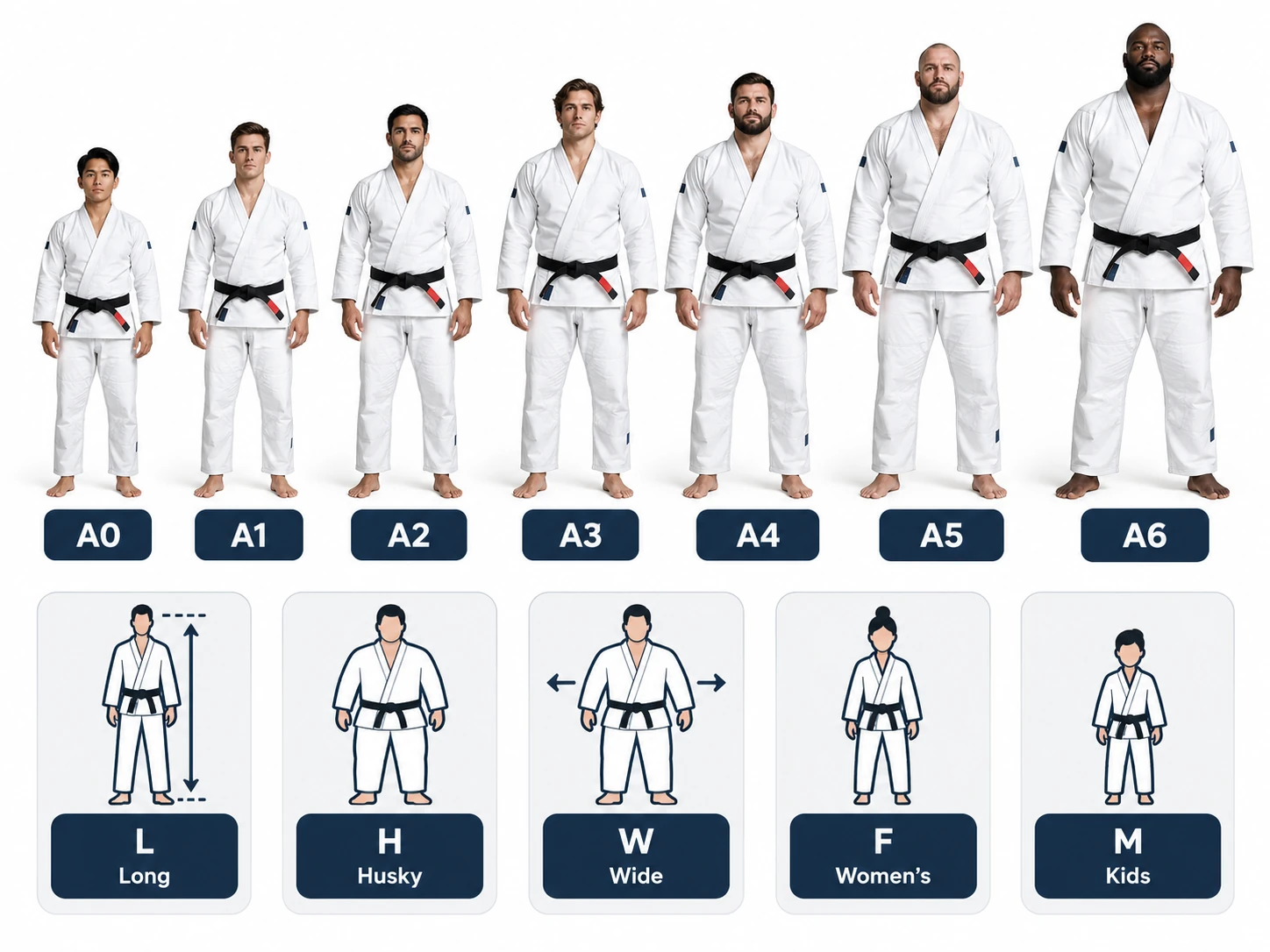
BJJ Gi size chart showing A0 to A6 sizes and L, H, W, F and M size variations

Size TermWhat It Usually IndicatesWho It May SuitWhat to Check Before Choosing
A0, A1Smaller adult sizesShorter or lighter adultsSleeve and pant length if you have long limbs
A2Middle of the adult rangeMany average-height adultsThe brand's height and weight range, which varies widely
A3Larger adult sizeTaller or heavier adultsChest width and jacket length
A4 to A6Largest standard adult sizesTall and heavy buildsWhether the brand offers a wider or longer version instead
L suffix (A2L)Long: extra sleeve and pant lengthTall, lean buildsWhether the torso width stays the same as the base size
H suffix (A2H)Husky or heavy: extra widthShorter, broader buildsShoulder, chest and pant-leg room
W suffix (A1W)Wide cut at some brandsBroad, stocky buildsWhether W means wide or women's at that brand
S suffix (A2S)Short or slim, depending on brandShorter or slimmer buildsThe brand's own definition of S
F prefix (F2)Women's sizing at many brandsWomen wanting a women's cutShoulder width, waist taper and hip room
M prefix (M1)Kids' sizing at many brandsChildren and youthHeight range and how much growing room the brand advises

Why Every BJJ Gi Size Chart Is Different

There is no single official sizing standard for BJJ Gis. Each brand writes its own BJJ Gi size chart from its own patterns, so the same label can describe noticeably different bodies. Here is how three brands' published charts described an A2 when checked in October 2026:

 
Brand (Published Chart)A2 HeightA2 Weight
Gold BJJ5'8" to 6'0"150 to 190 lbs
Kingz5'7" to 5'10"170 to 190 lbs
All Around5'8" to 6'0"165 to 194 lbs

A 5'11", 160 lb athlete fits Gold BJJ's A2 range, falls below the weight range on the other two charts, and is taller than Kingz's A2 height range. Those are three different answers from three charts using the same label.

Variation also exists inside one brand. Kingz publishes separate measurement tables by Gi model, and the pant measurement listed for an A2H differs between two of its models (100 cm on one, 94.5 cm on another). That is why the right BJJ Gi size chart is the one for the exact model you are buying, not a generic chart or the brand's chart for a different Gi.

How the A0 to A6 Size System Works

The adult A-scale runs from smaller numbers to larger ones, with each step adding length and room through the jacket and pants. Kingz describes A2 as the most common size on the mat, and a typical BJJ Gi size chart places it in the middle of the range.

The scale is not fixed at A0 and A6. Some brands add sizes below A0, such as A00 or W00 in women's lines, and some extend beyond A6. A BJJ Gi size chart may also skip sizes, or offer long and heavy versions only for certain numbers, so a missing size on one brand's chart says nothing about another's.

What L, H, W, S and F Mean in BJJ Gi Sizes

Letters after the number adjust the base size for body proportions. They are useful, but their meanings are set by each brand, so read the key on the BJJ Gi size chart before assuming.

  • L (Long): Kingz describes its L sizes as keeping the base size's torso width while adding sleeve and pant length, for tall, lean frames.
  • H (Husky or Heavy): Kingz describes H sizes as adding width through the chest, shoulders and lapel without excessively long pant legs, for broader builds.
  • W (Wide): All Around uses W for a broader, stockier cut. Fuji, by contrast, uses W as its women's prefix (W1, W2), so W can mean two unrelated things depending on the brand.
  • S (Short or Slim): One brand guide lists both meanings: S as short (shorter sleeves and pants) and S as slim (a tighter cut). Check which one a chart means.
  • F (Women's or Fitted): Many brands, including Kingz and Tatami, use F as a women's prefix (F1, F2). Some retailers also list F as a fitted cut. Prefix or suffix position is a clue, but the brand's chart is the only reliable definition.
  • Other labels: Some brands use T for tall, XL for extra long, or names such as "Curvy" and "Tall" in women's ranges.

How to Read a BJJ Gi Size Chart Step by Step

  1. Find the chart for the exact model. Product pages often link a model-specific BJJ Gi size chart, which can differ from the brand's general chart.
  2. Place your height and weight on the BJJ Gi size chart. If both land in the same row, that is your starting size.
  3. If they land in different rows, follow the brand's rule. Fuji says its sizing goes by weight and then height, and recommends the larger size when the two disagree. All Around tells buyers to go by weight and then choose a cut for their build. Rules differ, so use the one printed next to the chart.
  4. Check a modifier. If your weight fits a size but your sleeves are usually short, look for an L. If your height fits but your torso needs room, look for an H or W.
  5. Compare garment measurements. Check sleeve, jacket and pant lengths against a Gi or measurements that already work for you.
  6. Read the shrinkage and care note. It changes whether a close fit today stays close after washing.
  7. Read the return policy. Fuji, for example, accepts returns only on Gis that have not been washed or worn for practice, so try the Gi on before the first wash.

Height and Weight Are Not the Whole Story

Two athletes can share the same height and weight and still need different Gis. One may have a long torso and short legs; another, long arms and narrow shoulders; a third, a muscular upper body with lean legs. Height and weight cannot show any of that, so a BJJ Gi size chart that lists only those two inputs can only get you close.
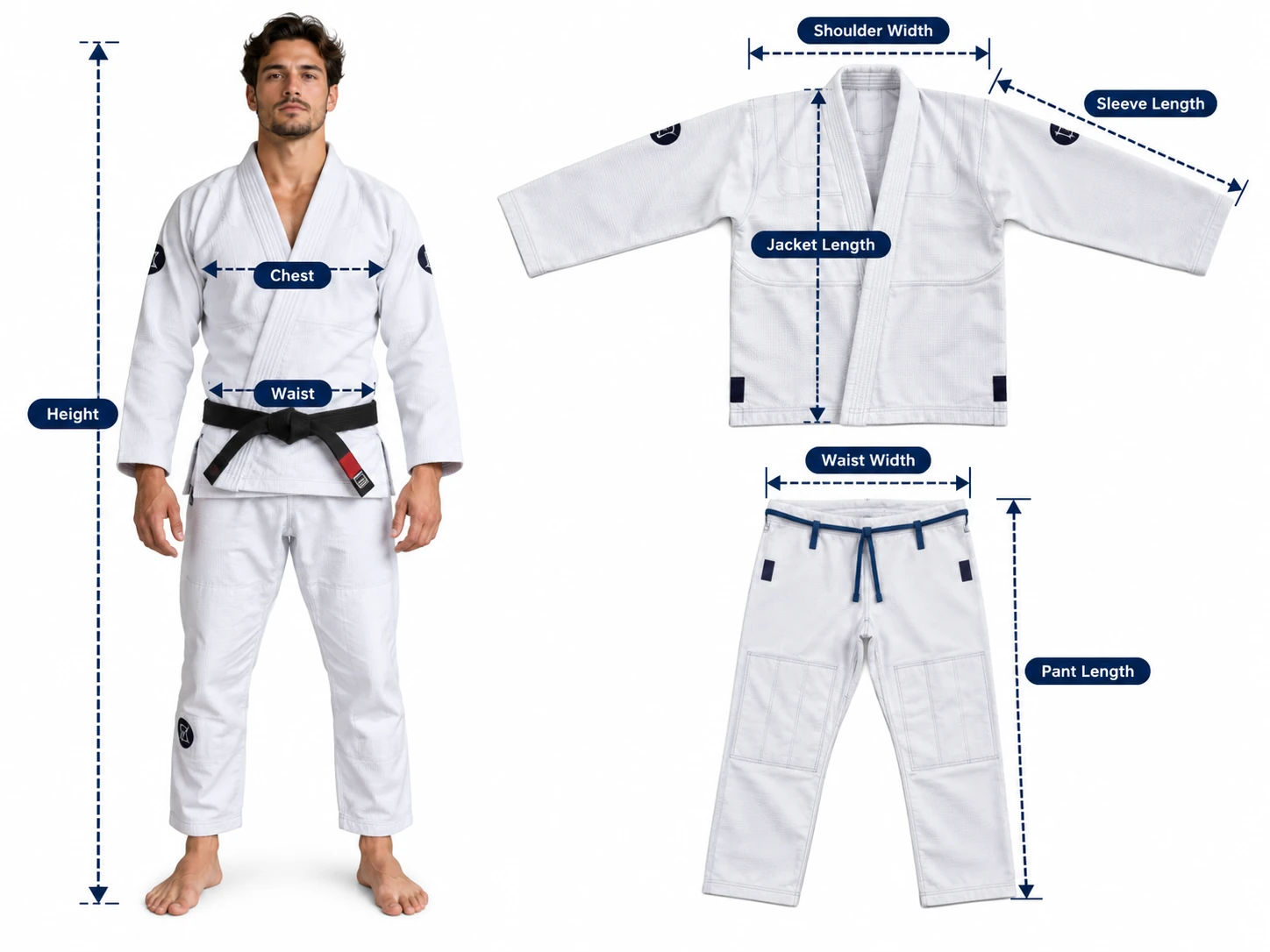
BJJ Gi size chart measurement guide showing height, chest, waist, shoulder, sleeve, jacket and pant measurements

Where a brand's BJJ Gi size chart includes garment measurements, compare them with a Gi or jacket that already fits you well. These are the measurements most worth checking:

MeasurementWhat It Tells YouWatch For
Chest widthRoom across the chest and backBrands measure differently; Kingz notes your chest should be smaller than its listed figure
Shoulder widthWhether the jacket sits on your shoulders or past themBroad shoulders may need an H or W cut
Jacket lengthCoverage below the beltThe jacket should reach the thigh for competition
Sleeve lengthWhere the cuff lands with your arm extendedBrands may measure from the shoulder or from the center back
Pant waistStarting point before the drawstringUsually less critical, because drawstrings adjust
Inseam or pant lengthWhere the hem lands at the ankleLong legs often need an L or longer pants
OutseamOverall pant length, waist to hemUseful if you wear pants high or low on the hips
RiseRoom through the seat and hipsMatters for powerful hips and thighs

Measurement diagrams vary, so read how each point is taken before comparing figures across brands. A few brands also let customers choose jacket and pant sizes separately, which solves many proportion problems on its own.

How Should a BJJ Gi Fit?

A BJJ Gi should let you move freely without loose fabric hanging off your body: the jacket reaches your thighs, the sleeves land near your wrists with your arms extended, and the pants end near your ankle bones.
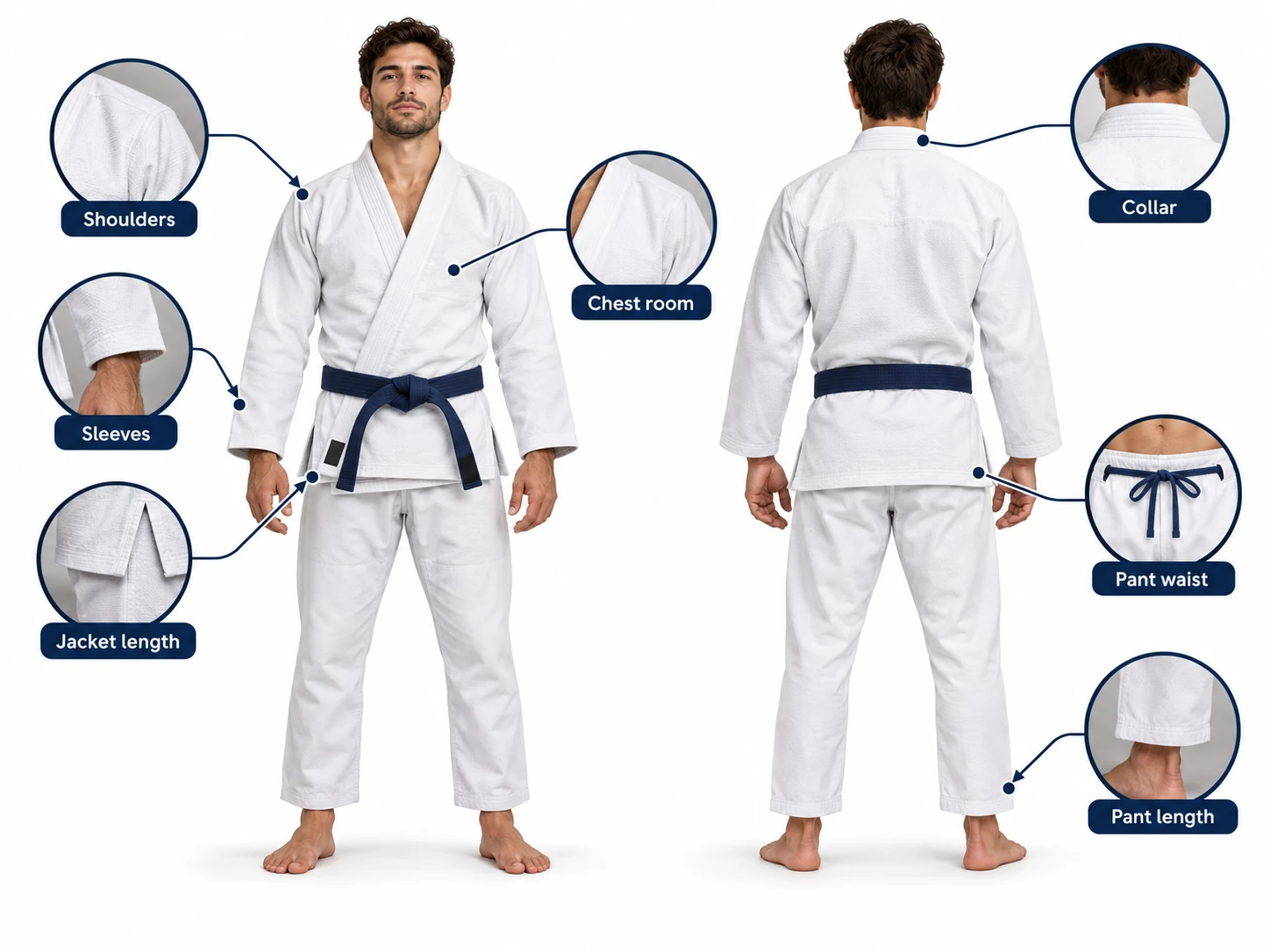
BJJ Gi size chart fit guide showing shoulder, sleeve, jacket, waist and pant length

  • Shoulders: The jacket should sit flat across your shoulders without pulling, and without so much width that fabric droops down the upper arm.
  • Chest and torso: You should be able to raise your arms, breathe deeply and frame without the fabric pulling tight across your back.
  • Jacket length: The hem should cover the hips and reach the thigh, and it should stay below the belt when you move.
  • Sleeves: With your arm straight out in front, the cuff should land close to the wrist and should not reach past your fingers.
  • Pant waist: The pants should sit securely at the waist once tied, without needing to be cinched hard.
  • Pant length: The hem should land near the ankle bone, not mid-shin and not dragging on the mat.
  • Too baggy: Excess sleeve and pant width gives partners extra fabric to grip and can catch on fingers and toes.
  • Too tight: A jacket that binds across the back or elbows restricts movement and limits how you frame and reach.

A BJJ Gi size chart gets you to the right size; these checks confirm the fit once the Gi arrives.

Training Fit vs. Competition Legality

A comfortable training Gi is not automatically legal for competition, and no BJJ Gi size chart can guarantee that it will be. Rules are set by each competition organizer, so check the rules for the event you enter.

Under the current IBJJF uniform requirements, the jacket must reach the thigh, sleeves may end no more than 2 cm from the wrist with the arm extended straight and parallel to the ground, and pants may end no more than 2 cm above the ankle bone. Inspectors also check lapel thickness (1.3 cm), collar width (5 cm) and the sleeve opening at full extension (7 cm). The IBJJF states that these rules took effect after the 2024 Gi World Championships.

Many sizing guides still quote an older 5 cm allowance, and the popular "four fingers from the wrist" check is much looser than 2 cm. If a Gi has to serve for both training and IBJJF competition, choose sleeve and pant lengths that sit close to the wrist and ankle, and recheck them after washing.

BJJ Gi Shrinkage and Size Selection

There is no universal shrinkage figure for BJJ Gis. Published estimates disagree widely, because shrinkage depends on fiber content, weave, any preshrinking during production, and how the Gi is washed and dried.

What matters for choosing a size:

  • Preshrunk is not shrink-proof. Fuji describes all its Gis as preshrunk but still recommends cold washing and hang drying, and says that with this method a Gi will shrink up to one inch.
  • Brand guidance differs. Sanabul says its preshrunk Gis do not need to be bought a size up, while some other brands state that their Gis are not preshrunk.
  • Heat is the main variable. Brands including Fuji, Sanabul and Kingz recommend cold washing and hang drying to protect the fit, which means a close-fitting Gi is safest with someone who will follow that care routine.

Use the shrinkage note on the brand's BJJ Gi size chart or product page, not a general rule, when deciding how much length to keep in reserve.

What If You Are Between BJJ Gi Sizes?

There is no correct default between "size up" and "size down." Work through these questions instead:

 
QuestionIf the Answer Is Yes
Does the brand state a rule for split height and weight?Follow it; it reflects how that brand graded its patterns
Is only length the problem?Look for an L size before jumping to a bigger regular size
Is only width the problem?Look for an H or W size before sizing up
Does the brand warn that the Gi may shrink?Favor the size that still reaches your wrists and ankles after washing
Will you compete under IBJJF rules?Avoid a size whose sleeves or pants are already at the limit
Will you wear a rash guard underneath?Allow for the layer; IBJJF requires a fitted shirt under the Gi in female divisions
Are returns limited to unwashed Gis?Try both sizes, or one, carefully before the first wash

If two sizes still look equally good, compare their garment measurements on the BJJ Gi size chart with a Gi you already like and choose the closer match.

Women's BJJ Gi Sizing

Many brands make women's Gis in separate size ranges rather than relabeled men's sizes. Kingz sizes women's Gis F0 to F5 and describes them as cut with narrower shoulders and a more tapered waist than its A-scale. Tatami also uses F sizes, while Fuji uses W sizes (W00 to W6 across its range). Other brands use labels such as "Curvy" or "Tall."

Women's charts still vary by brand. Fuji, for example, says its W2 shares the same height and weight categories as its A2, so the women's label does not automatically mean a smaller garment. Compare shoulder width, chest, hip room and pant length on the specific women's BJJ Gi size chart, and if a women's range does not suit your proportions, compare the brand's A-size measurements as well.

Kids BJJ Gi Sizing

Youth Gis use their own labels. M is common (Kingz and Tatami both use M sizes, from M0000 or M000 up to M4), while other brands use C, Y or K. Ranges differ between brands and sometimes between pages from the same brand, so always use the BJJ Gi size chart for the product being bought.

Growing room is the main temptation with kids' Gis. Kingz's kids guide advises against sizing up more than one size, because a jacket that is too big hangs loose on the mat. Long, loose sleeves and pant legs also give training partners extra fabric to grab and can catch fingers and toes. When a child outgrows the largest youth size, Kingz points families toward adult A0 or A1 sizes, or F0 or F1 for women's cuts.

Common BJJ Gi Sizing Mistakes

  • Assuming every brand's A2 fits the same.
  • Treating a generic BJJ Gi size chart as if it applied to every brand.
  • Choosing a size from height alone or weight alone.
  • Ignoring arm and leg length when a long or husky version exists.
  • Washing hot or tumble drying before deciding whether the fit is right.
  • Assuming women's sizes are simply smaller men's sizes.
  • Relying on outdated competition advice instead of the current IBJJF rules.
  • For brands: copying another company's chart, skipping physical samples, or publishing vague charts with no garment measurements.

How BJJ Brands Should Build a Gi Size Chart

For a brand, a size chart is the visible end of a longer development process. Putting A0 to A6 on labels is easy; making every size fit the customer it promises to fit is the real work. A dependable BJJ Gi size chart usually comes from this sequence:

StageWhat HappensWhat It Protects
Target customerDefine who the line is for: men's, women's, youth, competitors, beginnersThe right size range and fit philosophy
Base patternPerfect one middle size on a real fit modelThe fit everything else is graded from
GradingCreate the other sizes from the base patternProportion across the range
SamplesMake physical Gis in several sizesProblems flat patterns cannot show
Size validationFit-test, wash-test and adjustA chart that matches the finished product
ProductionCut and sew to the approved specificationsConsistency between orders

Define the Target Customer and Size Architecture

Decide which ranges you need (adult, women's, youth), how many sizes each range covers, and whether L and H versions are worth offering. Every extra variant adds patterns, samples and inventory, so add them where your customers' proportions justify it.

Understand Size Grading

Grading is the process of turning one base pattern into a full size range. It is not a matter of adding the same amount to every measurement. Different areas of the body change at different rates, and grade rules vary by brand and manufacturer; there is no universal set. Research published in the Clothing and Textiles Research Journal (Schofield and LaBat, 2005) found that several common grading assumptions were not supported by body-measurement data, which is a good reason to validate graded sizes on real people rather than trusting the arithmetic. Factories may also apply their own grading rules unless a brand specifies otherwise, so agree on grading before samples are cut.

Balance the Jacket and Pants

Height and weight do not move together across a population, and the jacket and pants do not have to grade identically. Check that sleeve length, jacket length and pant length grow in proportion with chest and seat room. Long and husky versions exist because a single grade cannot serve tall-lean and short-broad customers at once.

Test Shrinkage on the Real Fabric

Wash and dry samples using the exact care instructions you plan to print, then measure again. Publish measurements that reflect the garment the customer will wear after following those instructions, and say clearly whether the Gi is preshrunk.

Review a Sample Size Set, Not One Sample

One approved sample proves one size. Fit can drift toward the smallest and largest sizes, and jacket-to-pant proportions can drift with it. Reviewing samples above and below the base size, including the extremes, is sound product-development practice before committing to bulk.

Agree on Tolerances

Write down how far each finished measurement may vary from the specification and how it will be measured. Without agreed tolerances, two production runs can both be "A2" and still fit differently.

Publish a Chart Customers Can Use

A customer-facing BJJ Gi size chart should define every suffix the brand uses, show height and weight ranges, list finished garment measurements with a diagram of where each is taken, state which input to prioritize when height and weight disagree, and note shrinkage behavior and care. Each missing element leaves customers guessing.

Once your size architecture, grading, sample set and tolerances are settled, the next step is producing those specifications consistently at scale with a BJJ Gi manufacturer. Best Gym Wears is a Pakistan-based sportswear and fightwear manufacturer whose range includes BJJ uniforms for brands, gyms and teams.

BJJ Gi Size Chart FAQs

What BJJ Gi size should I get?

Start with the BJJ Gi size chart for the exact model, place your height and weight, and follow the brand's rule if they fall in different sizes. Then check sleeve, jacket and pant measurements, and consider an L or H version if your proportions are long or broad.

What does A2 mean in BJJ Gi sizing?

A2 is a middle adult size on the A-scale. Its exact height, weight and measurements are set by each brand, and published A2 ranges differ noticeably between brands.

Are BJJ Gi sizes the same across brands?

No. Brands publish different height, weight and measurement ranges for the same labels, and a single brand can list different measurements for the same size on different models.

What does L mean in BJJ Gi sizes?

L usually means long: extra sleeve and pant length while keeping the base size's width. Some brands also use T (tall) or XL (extra long) for similar adjustments.

What does F mean in BJJ Gi sizing?

At many brands, F is a women's size prefix, as in F1 or F2. Some retailers also use F for a fitted cut, so check the brand's own definition.

Do BJJ Gis shrink?

Many do, though by different amounts. Even preshrunk Gis can shrink somewhat, and hot washing or tumble drying generally increases shrinkage. Follow the brand's care instructions and size with its shrinkage note in mind.

Reading Any BJJ Gi Size Chart With Confidence

A BJJ Gi size chart is a starting point, not a guarantee. Use the chart for the exact model, treat letters like L, H, W and F as brand-defined, check garment measurements against your own proportions, account for shrinkage, and check current competition rules if you plan to compete.

For brands developing their own line, the same principles apply in reverse: define the customer, grade carefully, validate a full sample set, and publish a clear chart. If you are ready to turn your size system into finished Gis, you can discuss your specifications with Best Gym Wears as a custom BJJ Gi manufacturer.

Leave a Reply

Your email address will not be published. Required fields are marked *