

The main types of tank tops are the classic tank, A-shirt, muscle tank, stringer, racerback (including T-back and Y-back), camisole, halter, performance tank and compression tank. Names such as cropped, longline, high-neck or ribbed describe one feature, not a separate garment. Tank tops are classified by construction, back and strap style, neckline, fit, length and intended use, and one tank can belong to several of those groups at once.
This guide to the types of tank tops covers what each style is called, how to recognize it, how similar styles differ, which styles lead men's and women's ranges, and how a clothing brand can decide which ones to develop.
Types of Tank Tops at a Glance
Use this table to compare the nine core types of tank tops quickly. Each one is explained in more detail further down.
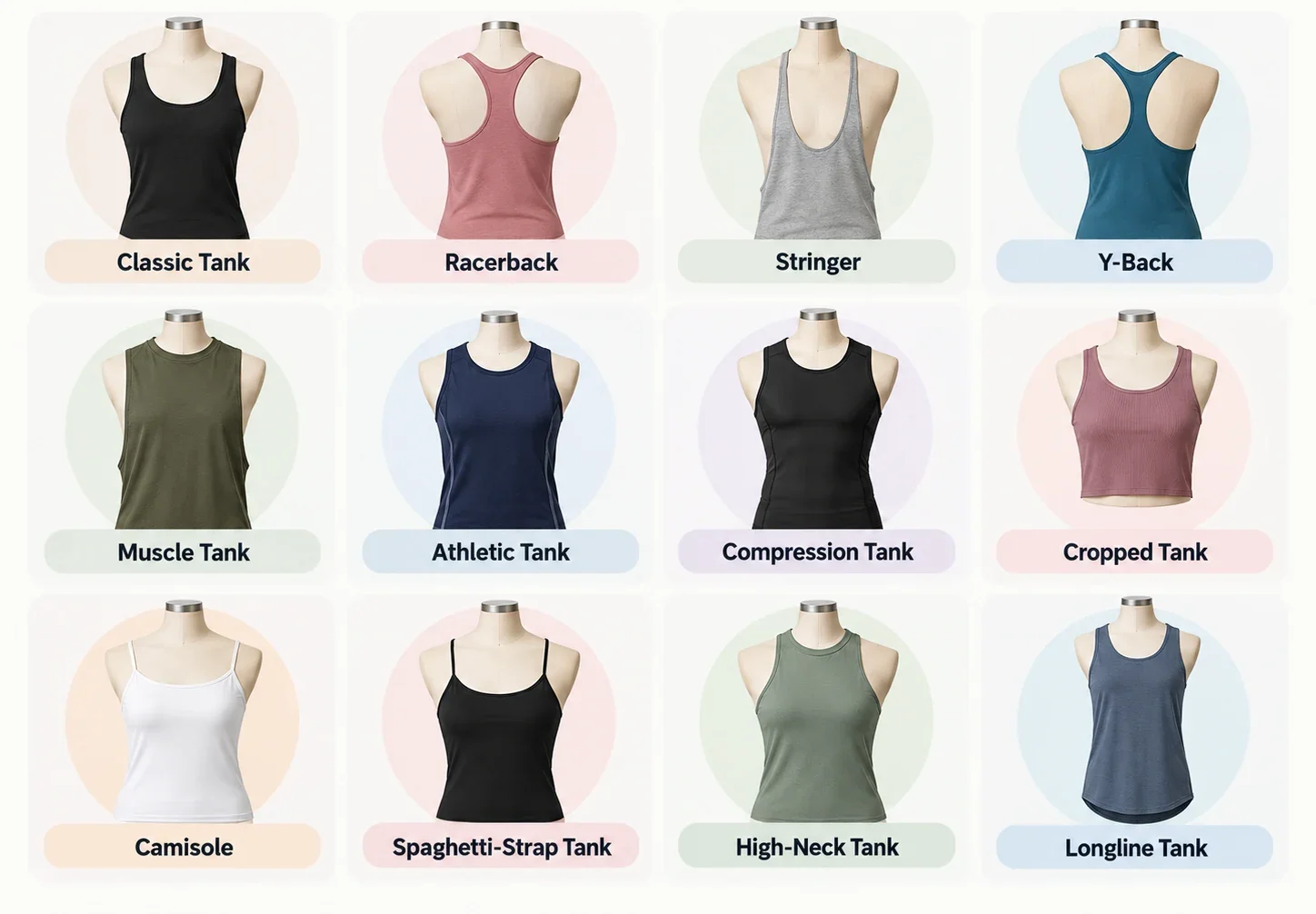
| Tank Top Type | How to Recognize It | Typical Use | Common Fit / Construction | Key Difference |
|---|---|---|---|---|
| Classic tank | Moderate straps, standard armholes | Everyday wear, layering, merchandise | Regular fit, straight body | The baseline for every other style |
| A-shirt (ribbed tank) | Rib knit, narrow straps, deep scoop neck | Undershirt, casual layering | Close fit | Close fit plus rib texture |
| Muscle tank | T-shirt shoulders, deep armholes | Gym, casual, graphic tops | Regular or relaxed | Opens the sides, keeps wide shoulders |
| Stringer | Very thin straps, very low armholes | Bodybuilding, weight training | Close to regular | Maximum upper-body exposure |
| Racerback (T-back, Y-back) | Straps meet toward the center of the upper back | Running, training, women's activewear | Fitted to regular | Defined by the back, not the front |
| Camisole (cami) | Thin, often adjustable straps, light fabric | Layering, sleepwear, evening wear | Close or slightly loose | Lightweight and strap-led |
| Halter tank | Straps fasten behind the neck | Summer and fashion wear | Usually fitted | Anchored at the neck |
| Performance tank | Light technical knit | Training, running, team sport | Any cut | Named for fabric and function |
| Compression tank | Skin-tight, no loose fabric | Base layer, lifting | Cut smaller than the body | Defined by degree of fit |
How the Types of Tank Tops Are Classified
Most confusion about tank top names comes from one habit: a single garment is usually described with several words, and each word refers to a different characteristic. A retail listing might call a product a "ribbed slim-fit racerback tank with a high neck." That is not four types of tank tops. It is one tank described by fabric, fit, back construction and neckline.
It also explains why published lists of types of tank tops range from a handful of styles to several dozen: the longer lists count every descriptor as a separate type. Six dimensions cover almost every name in use.
| Dimension | What It Describes | Common Terms |
|---|---|---|
| Body and armhole construction | Basic cut, strap width, armhole depth | Classic, A-shirt, muscle tank, stringer, camisole, halter |
| Back and strap style | Strap shape and where straps meet at the back | Standard back, racerback, T-back, Y-back, spaghetti strap, adjustable strap |
| Neckline | Shape and depth of the front opening | Scoop, crew, V-neck, high neck, square neck |
| Fit | Room between fabric and body | Compression, fitted, regular, relaxed, oversized |
| Length | Where the hem sits | Cropped, standard, longline, tunic |
| Purpose and fabric | What the tank does and what it is made from | Performance, athletic, casual, fashion, ribbed, mesh |
Read a product name across these dimensions and it becomes clear. A "cropped racerback performance tank" is cropped (length), racerback (back construction) and performance (purpose): one garment, not three. Brands do not name the types of tank tops consistently, so the visual cues below are more reliable than the label.
Different Types of Tank Tops
The nine styles below are the core types of tank tops, because each one changes a garment's basic construction or identity. Variations that change only one feature are grouped in a table after them.
Classic Tank Top
The classic tank, also called a basic tank, has shoulder straps of moderate width, armholes at a standard depth, a scoop or crew neckline and a straight body that usually falls to around the hip.
- How to recognize it: Nothing about it is extreme. The straps cover a fair part of the shoulder, the armhole stops well above the ribs, and the back mirrors the front.
- Typical use: Everyday wear, layering, warm-weather casualwear and printed merchandise.
- How it differs: A muscle tank has bigger armholes, a stringer has far thinner straps, and a racerback cuts the back away.
- For brands: Of all the types of tank tops, the classic has the fewest construction variables and a broad, flat front for printing, which makes it a practical starting point for basic and merchandise ranges.
A-Shirt (Ribbed Tank)
The A-shirt is a close-fitting tank, most often in ribbed cotton, with narrow straps and a deep scoop neckline. It started as an undershirt and is now also worn on its own.
- How to recognize it: Vertical rib texture, a body-hugging fit and a deep U-shaped neckline. The straps are narrower than a classic tank's but wider than a stringer's.
- Typical use: Undershirt, casual layering and minimal summer outfits.
- How it differs: It is essentially a classic silhouette taken closer to the body and made in rib knit.
- A note on names: The A-shirt also carries an offensive slang name. For product listings, "A-shirt" or "ribbed tank" is the neutral choice.
Muscle Tank (Sleeveless Tee or Drop-Arm Tank)
A muscle tank looks like a T-shirt with the sleeves removed. The shoulders stay wide, but the armholes are cut larger and lower than on a classic tank, exposing more of the sides and upper arms.
- How to recognize it: Look at the shoulders first. If they are broad like a T-shirt's and the armhole is noticeably deep, it is a muscle tank. It is also sold as a muscle shirt, sleeveless tee or drop-arm tank.
- Typical use: Gym training, casual summer wear and graphic or slogan tops.
- How it differs: It keeps a full back and wide shoulders, which makes it the least revealing of the gym-oriented types of tank tops.
- For brands: The wide chest and solid back leave more room for prints than cut-away styles. Confirm armhole depth on the sample, because "muscle tank" can mean anything between a gently enlarged armhole and a deep drop-arm cut.
Stringer Tank
A stringer is a gym tank with very thin straps and armholes dropped low on both sides, exposing most of the shoulders, the sides of the chest and the upper back. Bodybuilders and lifters wear it for freedom of movement and to show muscle definition.
- How to recognize it: The straps look like strips or cords, and the armhole can drop close to the bottom of the chest. The back usually forms a Y or T, leaving the shoulder blades open.
- Typical use: Bodybuilding, weight training and physique-focused gym wear.
- How it differs: A stringer is defined by how little fabric it has at the strap and side. Its back shape is a separate detail, which is why both "Y-back stringers" and "T-back stringers" are sold.
- For brands: The stringer is the most revealing of the common types of tank tops, and its narrow front panel limits print size. Small chest logos and back-neck branding tend to suit it better.
Racerback, T-Back and Y-Back Tanks
A racerback is a tank whose straps move inward toward the center of the upper back instead of running straight down over the shoulder blades. The shoulder blades are left uncovered and the straps are less likely to slip off the shoulders during movement.
- How to recognize it: Turn the garment around. If the back narrows into a T or Y shape between the shoulder blades, it is a racerback.
- T-back versus Y-back: These names are used inconsistently. When a brand does separate them, a T-back usually has a center panel that rises toward the neckline before splitting, while a Y-back's straps meet lower down and form a fork.
- Typical use: Running, training and yoga, much of women's activewear, and many men's gym stringers.
- How it differs: Racerback is one of the types of tank tops defined entirely by the back. The front can be a scoop, crew or high neck, and the fit can be relaxed or compressive.
Camisole and Spaghetti-Strap Tanks
A camisole, or cami, is a light sleeveless top with thin straps, traditionally worn by women and usually reaching to around the waist. It began as an undergarment and is now widely worn as outerwear. "Spaghetti strap" describes the very thin straps a camisole often has.
- How to recognize it: Thin straps, often adjustable, and a lightweight body in fabrics such as cotton, satin, nylon or stretch blends.
- Typical use: Layering, sleepwear, warm-weather wear and dressier outfits.
- How it differs: Not every spaghetti-strap tank is a camisole. A thin-strapped tank in heavier rib knit or sports fabric tends to be sold as a tank, while a lighter, finer version tends to be called a cami.
Halter Tank
A halter tank has straps, or a single band, that run around the back of the neck rather than over the shoulders. The shoulders and much of the upper back are left bare.
- How to recognize it: Follow the straps. If they meet behind the neck instead of crossing the shoulder blades, it is a halter.
- Typical use: Summer and fashion wear, mostly in women's ranges.
- How it differs: The halter is the only one of these core types of tank tops anchored at the neck rather than the shoulders, which changes how it hangs and how it is supported.
Performance (Athletic) Tank
A performance tank, often sold as an athletic tank, is defined by fabric and function rather than one fixed cut. It is usually made from a lightweight synthetic or blended knit that dries quickly, and it may add mesh zones, flatlock seams or bonded edges.
- How to recognize it: The fabric gives it away: a smooth, light technical knit rather than plain cotton jersey. The cut may be classic, racerback, muscle or stringer.
- Typical use: Running, training, team sport and hot-weather workouts.
- How it differs: Unlike most types of tank tops, it is named for what it does. A classic tank and a performance tank can share a pattern and differ only in fabric and finishing.
Compression Tank
A compression tank is cut smaller than the body's own measurements in a high-stretch fabric, so it presses firmly against the chest and torso.
- How to recognize it: No loose fabric anywhere on the body. It stretches visibly when worn and springs back when taken off.
- Typical use: Base layer, lifting and sport.
- How it differs: A fitted tank follows the body; a compression tank presses against it. The difference comes from pattern sizing and the fabric's stretch and recovery.
- For brands: Because compression depends on pattern and fabric working together, judge it on a worn sample, not from flat measurements alone.
Variations Named After a Single Feature
These names appear constantly in listings, but they are not separate types of tank tops in their own right. Each changes one characteristic and can be combined with the core styles above.
| Variation | Dimension | What Changes | Often Combined With |
|---|---|---|---|
| Cropped | Length | Hem ends above the natural waist | Racerback, fitted, performance |
| Longline | Length | Body extends past the hips, sometimes with a curved hem | Muscle, stringer, oversized |
| Tunic | Length | Long enough to cover the hips | Relaxed women's tanks |
| High-neck | Neckline | Front neckline close to the base of the neck | Racerback, fitted |
| V-neck | Neckline | V-shaped front opening | Classic, relaxed |
| Scoop neck | Neckline | U-shaped front opening | Classic, A-shirt, camisole |
| Square neck | Neckline | Straight horizontal cut across the front | Fitted, ribbed |
| Ribbed | Fabric | Vertical rib-knit texture with natural stretch | A-shirt, fitted women's tanks |
| Mesh | Fabric | Open, breathable knit | Performance, stringer |
| Oversized | Fit | Extra room through body and shoulders | Muscle, longline |
| Hooded | Added feature | Hood on a sleeveless body | Muscle, gym |
| Shelf-bra | Added feature | Built-in inner support layer | Camisole, fitted women's tanks |
Frequently Confused Tank Top Styles
A handful of name pairs cause most of the mix-ups between types of tank tops.
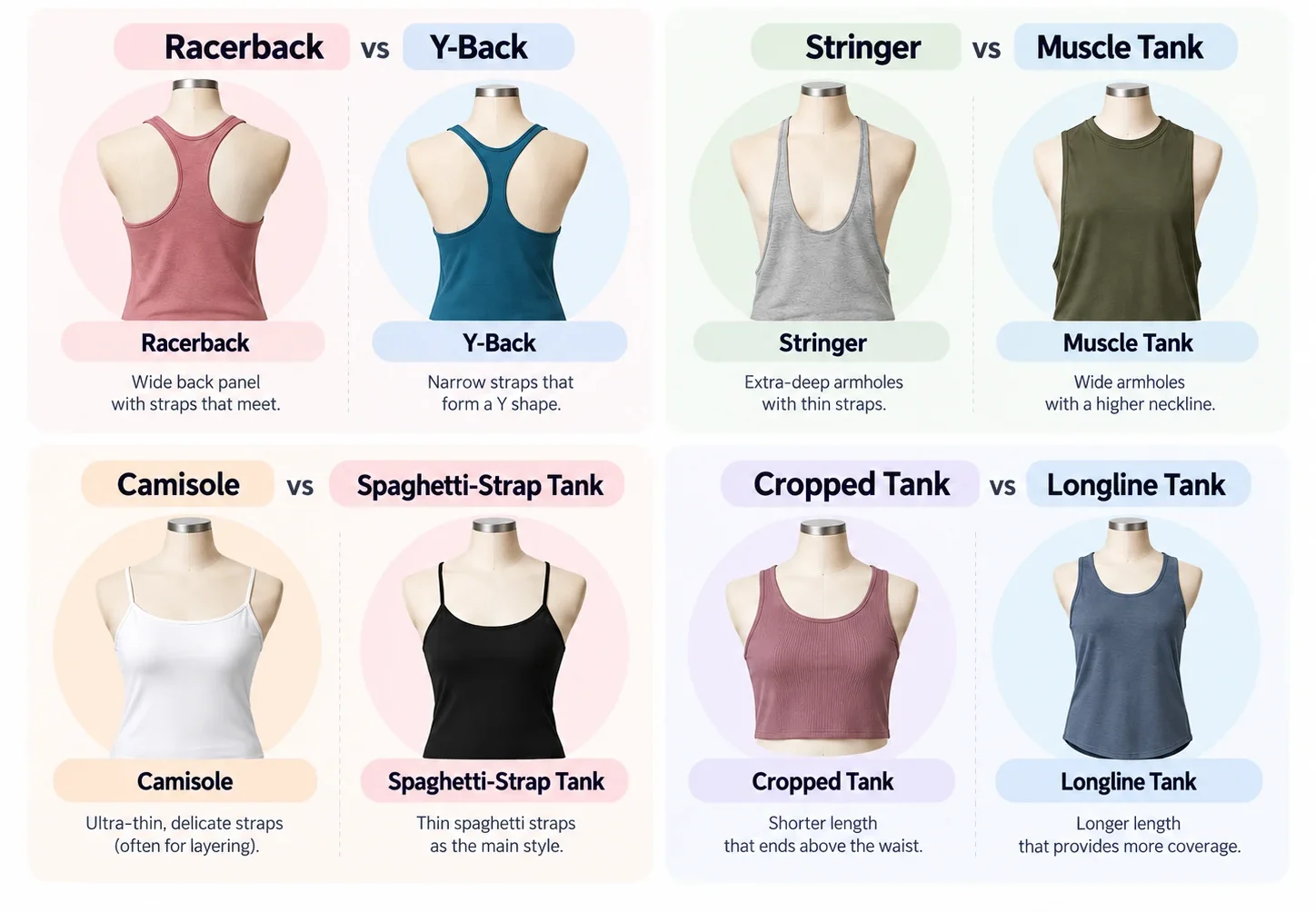
Stringer vs. Muscle Tank
Both expose the arms and sides. The muscle tank keeps T-shirt-like shoulders and a full back; the stringer cuts the straps to thin strips and usually opens the back into a Y or T. If most of the shoulder blades are visible, it is a stringer.
Racerback vs. Y-Back
Y-back is one form of racerback. Racerback is the umbrella term for any back where the straps move toward the center, and Y-back describes straps that join low and fork. Brands use both loosely, so trust the back view.
Camisole vs. Spaghetti-Strap Tank
Spaghetti strap names the strap; camisole names the garment. Most camis have spaghetti straps, but a spaghetti-strap tank in sportier fabric is usually sold as a regular tank.
Classic Tank vs. Athletic Tank
The cut can be identical. The difference is usually fabric: cotton or cotton-blend jersey for the classic, a quick-drying technical knit for the athletic version.
Fitted vs. Compression Tank
A fitted tank leaves little spare fabric. A compression tank is cut smaller than the body. On a hanger they can look alike; worn, they feel very different.
Muscle Tank vs. Muscle Fit
These point in opposite directions. A muscle tank is usually a looser sleeveless tee with deep armholes, while "muscle fit" normally means a closer cut through the chest and arms. When a listing says "muscle-fit tank," check whether it refers to the cut, the fit or both.
Types of Tank Tops for Men
Men's ranges draw on a narrower set of types of tank tops, weighted toward gym and casual wear. These are the styles most commonly found in men's collections.
| Style | What Sets It Apart | Common Setting |
|---|---|---|
| Classic tank | Moderate straps, standard armholes | Everyday wear, layering |
| A-shirt | Ribbed, close fit, deep scoop neck | Undershirt, casual |
| Muscle tank or sleeveless tee | Wide shoulders, deep armholes | Gym, casual, graphic tops |
| Stringer | Thin straps, very low armholes | Bodybuilding, lifting |
| Y-back or T-back | Back cut toward the center | Gym, training |
| Performance tank | Quick-drying technical fabric | Running, training, sport |
| Compression tank | Skin-tight, high stretch | Base layer, lifting |
| Longline tank | Extended body length | Gym, streetwear |
For guys choosing between the three most common gym options, the real question is exposure. A muscle tank opens the arms and sides, a Y-back opens the shoulder blades, and a stringer opens all of them.
Regional names differ too. In the UK, a tank worn as an undershirt is commonly called a vest, and in Australia and New Zealand the usual word is singlet. In US sport, singlet can also mean the one-piece wrestling suit, so be specific.
Types of Tank Tops for Women
Women's collections use more of the types of tank tops covered above, with a wider mix of strap, neckline and length variations. Women's tanks are also usually cut with smaller armholes than men's, which matters for any unisex style.
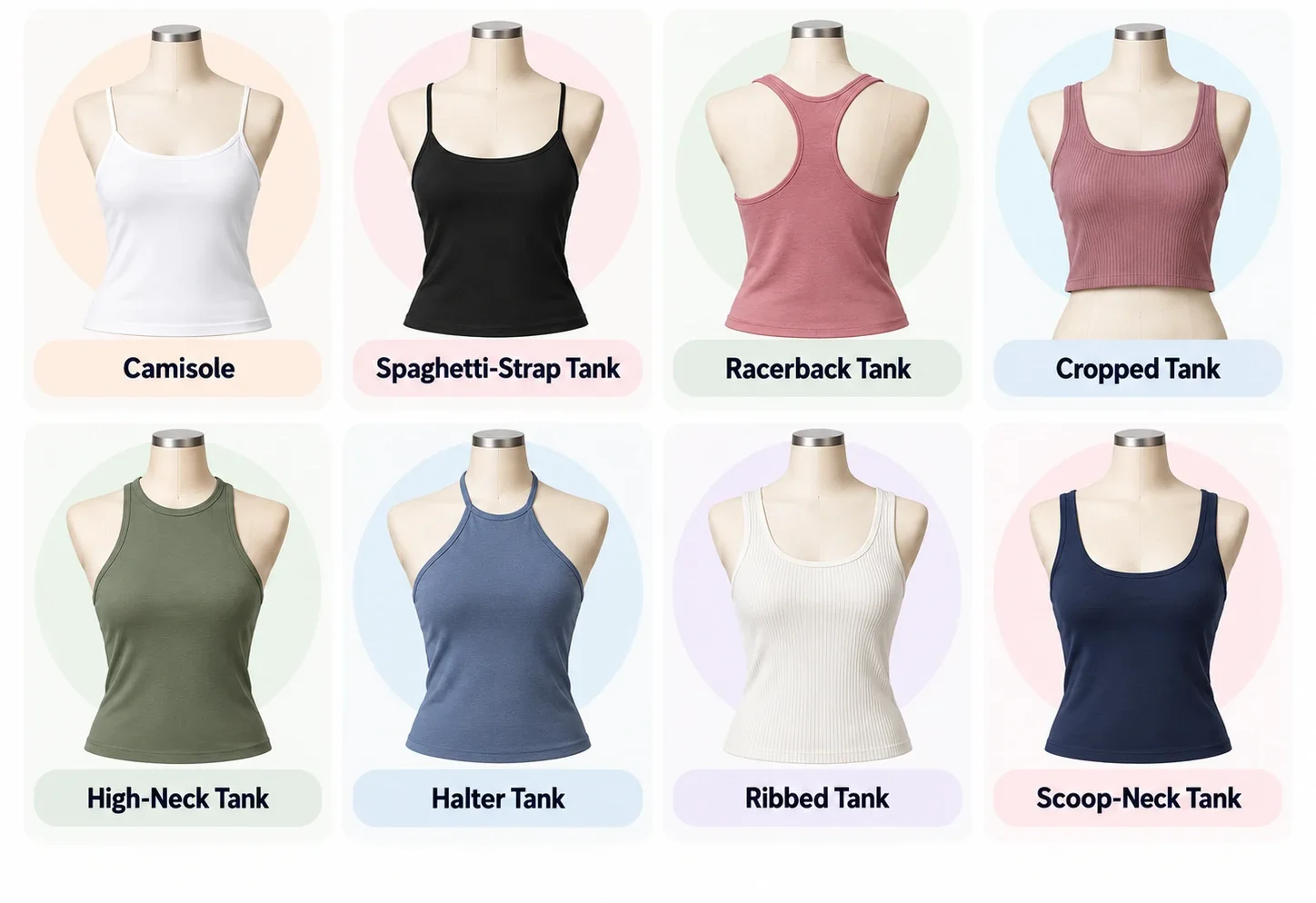
| Style | What Sets It Apart | Common Setting |
|---|---|---|
| Racerback tank | Back narrows between the shoulder blades | Running, yoga, training |
| Cropped tank | Hem above the natural waist | Gym, casual, fashion |
| Camisole or spaghetti strap | Very thin, often adjustable straps | Layering, evening, sleepwear |
| High-neck tank | Neckline near the base of the neck | Training, smart-casual |
| Halter tank | Straps meet behind the neck | Summer, fashion |
| Fitted performance tank | Close cut in technical fabric | Studio and gym training |
| Ribbed tank | Vertical rib knit, close fit | Everyday wear, layering |
| Relaxed or flowy tank | Loose body that drapes away from the torso | Casual, beach |
| Tunic tank | Long enough to cover the hips | Casual, layering |
Many women's activewear tanks combine several of these, for example a high-neck cropped racerback in fitted performance fabric. Some add a built-in shelf bra, making the tank a support layer as well as a top.
Tank Top Names at a Glance
Some names below are true types of tank tops; others describe one feature or are regional words for the same garment.
- Tank top: In the US and Canada, any casual sleeveless shirt.
- Classic or basic tank: Moderate straps, standard armholes, straight body.
- A-shirt: Close-fitting ribbed tank with a deep scoop neck.
- Muscle tank, muscle shirt or sleeveless tee: T-shirt shape without sleeves, deep armholes.
- Drop-arm tank: Armholes cut lower than standard; often another name for a muscle tank.
- Stringer: Very thin straps, very low armholes, usually a Y or T back.
- Racerback: Straps move toward the center of the upper back.
- T-back: Racerback with a center panel that rises before splitting.
- Y-back: Racerback whose straps join lower and fork.
- Camisole (cami): Light, thin-strapped top, usually women's.
- Spaghetti strap: The very thin strap itself, not a garment type.
- Halter: Straps or a band fasten behind the neck.
- Performance or athletic tank: Named for technical fabric and function.
- Compression tank: Cut smaller than the body in high-stretch fabric.
- Cropped tank: Hem ends above the waist.
- Longline tank: Length extends past the hips.
- High-neck tank: Neckline close to the base of the neck.
- Vest: British English for a tank-style undershirt.
- Singlet: Australian and New Zealand word for a tank; in US sport, also a wrestling suit.
- Tube top: Not a tank top, because it has no straps.
How Clothing Brands Can Choose the Right Tank Top Style
For a brand, choosing between types of tank tops is a product decision, not a vocabulary exercise. The style affects who the product suits, how it performs, where branding can go and how much sampling it needs.
Start With the Customer and the Activity
The right types of tank tops for a collection depend on who will wear them and what they will do in them. These pairings are illustrative, not fixed rules:
- A bodybuilding or physique-focused brand may look first at stringer and Y-back silhouettes.
- A women's fitness collection may build around racerback and fitted cropped styles.
- A streetwear collection may explore oversized, longline or muscle silhouettes.
- A basic merchandise or event range may prioritize the classic tank for its simplicity and print area.
- A running or team-sport line may start with a performance tank in a classic or racerback cut.
Balance Coverage Against Mobility
Every cut-away adds freedom of movement and removes coverage. Three measurements control most of that trade-off:
- Strap width decides how much shoulder is covered and how secure the strap feels.
- Armhole depth decides how much of the side and chest shows. A depth that works on a men's stringer may expose far too much on a women's or unisex style.
- Neckline depth at front and back affects coverage, layering and label or print position.
Check How the Style Affects Branding
Each of the types of tank tops in this guide offers a different branding area. A classic or muscle tank has a broad chest and full back for prints. A stringer or racerback leaves narrow panels, so small chest logos or back-neck prints work better. Dense embroidery can distort very light or high-stretch fabrics, so test it on a sample first.
Decide Gender Positioning Early
Not all types of tank tops translate well to unisex sizing. Men's, women's and unisex tanks are cut differently, especially at the armhole and chest. A unisex tank needs an armhole depth and strap width that work for both audiences, which usually points to a more moderate cut than a men's stringer or a women's racerback.
Confirm the Style on a Sample
Names are not specifications. Two factories can produce very different garments from the word "racerback." A physical sample, checked on the target customer and in the intended activity, is the most reliable way to confirm the style before bulk production.
What to Define Before You Brief a Factory
Saying "we want tank tops" leaves the important decisions to someone else. A clearer brief defines the attributes below. The example column follows one product, a longline muscle tank for a gym and streetwear line.
| Attribute | What to Decide | Example |
|---|---|---|
| Silhouette | Which core style | Muscle tank |
| Fit | How close to the body | Relaxed |
| Back construction | Standard, racerback, T-back or Y-back | Standard back |
| Strap width | Narrow, moderate or wide | Wide, T-shirt-like shoulder |
| Armhole depth | Standard, enlarged or dropped | Enlarged |
| Neckline | Shape, plus front and back depth | Crew neck |
| Body length | Cropped, standard or longline | Longline |
| Intended use | Activity and setting | Gym and streetwear |
| Branding placement | Prints, embroidery and labels | Large front print, back-neck label |
| Size range | Sizes and gender positioning | Men's sizing |
This stays focused on choosing the style. Fabric selection, graded measurements and the full tech pack are later steps.
Once you have settled on the style, fit and construction, the next step is turning those decisions into a sample and then into bulk production. Best Gym Wears is a Pakistan-based tank top manufacturer that works with fitness brands, gyms, teams and wholesale buyers on custom and private label gym wear, including tank tops and stringers.
Frequently Asked Questions
How many types of tank tops are there?
There is no official number. Published lists of types of tank tops range from about 8 to 35 styles, mainly because some count every neckline, length and fabric as its own type. Counting only styles that change the garment's construction gives the nine core styles in this guide.
What are the main types of tank tops called?
The main types of tank tops are the classic tank, A-shirt, muscle tank, stringer, racerback (including T-back and Y-back), camisole, halter, performance tank and compression tank. Cropped, longline, high-neck and ribbed describe single features that can apply to any of them.
What is the difference between a stringer and a Y-back?
Stringer describes the overall cut: very thin straps and very low armholes. Y-back describes only the back shape. Many stringers have a Y-back, some use a T-back, and a Y-back can also appear on tanks that are not stringers.
What are men's tank tops called?
In the US, men's tanks are usually named by style: classic tank, A-shirt, muscle tank or sleeveless tee, stringer, Y-back and performance tank. In the UK, a tank worn as an undershirt is commonly called a vest; in Australia and New Zealand, singlet is the usual term.
Is a camisole a tank top?
In US usage, a camisole is generally treated as a type of tank top. It is set apart by thin, often adjustable straps, light fabric and its traditional role as a women's layering piece.
Choosing Between the Types of Tank Tops
Most types of tank tops come down to six decisions: strap width, armhole depth, back shape, fit, hem position and purpose. Learn to read those six things and almost any tank top name becomes easy to decode, for shoppers and product developers alike.
If your brand is ready to develop its own range, you can take the style decisions from this guide to Best Gym Wears, a custom tank top manufacturer working with fitness and apparel brands on private label gym wear.