

Muay Thai shorts are short, wide-legged fight shorts with a tall elastic waistband and open side slits, built so the hips and thighs can move freely through kicks, knees and clinch work. What separates one pair from another is not the name on the waistband but four linked decisions: the fabric, the cut, the construction of the waistband and slits, and the way the shorts are sized and decorated. This guide explains each of those decisions, how they affect fit and appearance, and how a brand or gym turns them into a specification a factory can sample and produce.
What Makes Muay Thai Shorts Different From Other Athletic Shorts
Most athletic shorts are designed around running or general training. Muay Thai shorts are designed around one problem: fabric must never catch the leg at the top of a kick. That single requirement explains almost every feature.
- Short length. The hem sits high on the thigh, so there is less fabric in the path of a raised knee.
- Wide leg opening. A loose hem lets the thigh rotate and lift without pulling the shorts up or sideways.
- Side slits. An opening on the outer seam removes the last point of resistance when the leg swings out.
- Tall elastic waistband. With no fly, laces or hook fastening, the band holds the shorts in place and doubles as the main branding panel.
- Lightweight, smooth fabric. Satin and similar fabrics slide over the skin rather than clinging when wet.
Thai boxing shorts and Muay Thai shorts are the same garment under two names. MMA shorts are longer and cut for grappling on the mat, so they solve a different problem.
What Are Muay Thai Shorts Made Of?
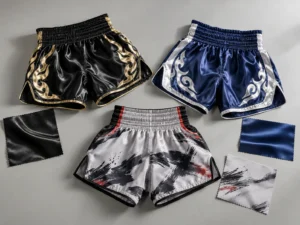
Muay Thai shorts are usually made from polyester satin, with printable polyester, microfiber and nylon as the common alternatives. An important detail is often missed: satin is a weave, not a fiber. Most "satin" fight shorts are woven from polyester, which is why a satin pair and a sublimated training pair can share the same fiber content yet look and feel completely different.
Polyester Satin
Polyester satin is the traditional choice. Its satin weave floats yarns across the surface, which creates the reflective sheen fighters expect under ring lights. It drapes well, carries strong solid colors, and provides a smooth base for embroidery, patches and appliqué lettering. Satin quality varies widely between mills, so the same description can cover fabrics with very different weight, handle and durability.
Heavy Satin
Heavy satin uses a denser construction. It holds panel shapes crisply, keeps a boxy traditional silhouette, and supports large layered front lettering without collapsing. The trade-off is more weight and a stiffer feel, which some fighters like and others find less comfortable for long training sessions.
Sublimation Polyester and Microfiber
Printable polyester and microfiber fabrics are chosen when the design itself is the product: gradients, photographic panels, sponsor logos or edge-to-edge patterns. Dye sublimation bonds dye into polyester fibers, and the higher the polyester content, the stronger the result. These fabrics usually feel softer and less shiny than satin, and many are marketed as quick-drying.
Lightweight Woven Polyester and Nylon
Lighter woven polyesters suit training shorts and modern cuts where a lower shine and a lighter feel matter more than a traditional look. Nylon also appears in the category, mostly in budget ranges and certain bright or neon colors. Quality varies considerably, so opacity when wet should be checked on a physical sample.
Lining
Most pairs are unlined. A light lining can still be useful behind pale colors that would otherwise show through, under heavy front appliqué that needs support, or where a brand wants extra coverage. Lining adds weight and warmth, so it is a deliberate choice rather than a default.
| Fabric | Look and Hand | Structure | Decoration Fit | Typical Use | Buyer Consideration |
|---|---|---|---|---|---|
| Polyester satin | Smooth, reflective, fluid drape | Medium | Embroidery, patches, appliqué, selected printing | Traditional and retro fight shorts | Judge sheen and handle on a swatch, not a photo |
| Heavy satin | Dense, crisp, noticeably heavier | High | Large appliqué and layered lettering | Structured traditional styles | Heavier on the body; confirm comfort in training |
| Sublimation polyester or microfiber | Soft, low to medium shine | Low to medium | Full sublimation | All-over graphics, team and academy designs | Base must be light; sublimation cannot print white |
| Lightweight woven polyester | Matte to low sheen, light feel | Low | Printing, sublimation, small embroidery | Modern cuts and training shorts | Check opacity and how decoration affects drape |
| Nylon | Light, often bright | Low | Printing, small embroidery | Budget and neon-color ranges | Quality varies; test for see-through when wet |
For a wider view of materials used across gym and combat apparel, see these fabric options for custom apparel.
Traditional vs Retro vs Modern Muay Thai Shorts
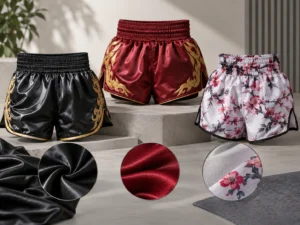
The core difference is proportion. Traditional Muay Thai shorts sit high on the waist with a roomy, wide leg; retro Muay Thai shorts shorten and slim the leg and open the side further; modern cuts usually lower the waistband and tailor the fit.
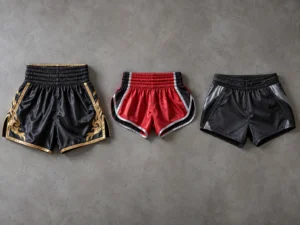
A caution before relying on style names: brands use them inconsistently. One label calls a short, slim, high-cut style "retro", while another uses "retro" for a lower-rise design. Two factories can interpret the same word differently, so a buyer should always define a cut by measurements rather than by its name.
Traditional Muay Thai Shorts
Traditional Muay Thai shorts have a tall multi-row waistband, generous room through the seat and hips, and a wide, boxy leg. They carry large front lettering and remain the expected look for Thai-style fight nights and heritage ranges. Many fighters roll the waistband once to shorten the leg, which is part of why the band is cut tall.
Retro Muay Thai Shorts
Retro Muay Thai shorts use a shorter inseam, a narrower leg and a higher side opening. They look lighter and more athletic, suit piping, contrast binding and compact logos, and give less fabric in the path of a kick. The slimmer leg is also less forgiving across sizes, which makes grading more sensitive.
Modern Low-Profile Cuts
Modern cuts generally use a narrower or lower waistband and a more tailored leg, sometimes in stretch fabrics. They fit brands that sell across several striking disciplines or want fight shorts that sit comfortably alongside rash guards and training tops.
Custom-Panel Designs
Any of these cuts can be built from extra panels. Side inserts, contrast legs, mesh vents or colored slits change how artwork is split, where seams fall, and which decoration methods can be used on each piece.
| Cut | Waistband Profile | Leg Length | Side Opening | Silhouette | Typical Design Use |
|---|---|---|---|---|---|
| Traditional | Tall, multi-row elastic, high rise | Mid-thigh, fuller | Moderate to deep slit | Wide and boxy | Large front lettering, Thai-inspired artwork |
| Retro | Medium to tall band | Shorter | Higher, more open | Compact and slimmer | Piping, binding, small logos, clean color blocks |
| Modern | Narrower or lower band | Short to mid-thigh | Varies by design | Tailored | Minimal branding, crossover fightwear |
| Custom-panel | Any | Any | Built into panel design | Depends on base cut | Color blocking, side inserts, zoned artwork |
Waistband, Side Slit and Leg Opening: The Construction That Defines Fit
Fabric sets the look, but construction decides whether the shorts stay in place and let the legs move.
Waistband
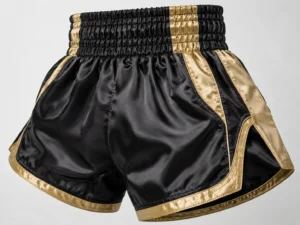
The waistband holds the shorts up with elastic alone. A tall band with several rows of stitched elastic spreads pressure over a wider area and suits the traditional look, while a narrower band suits modern cuts. Brands should specify band height, the number of elastic rows, stretch and recovery, and whether an internal drawcord is included. Because the band is the most visible branding panel, any waistband logo has to be planned together with the band height.
Side Slit
The side slit is an opening at the outer seam or between panels. Its depth and shape (straight, notched or curved) change how freely the leg can swing out. A deeper slit adds mobility and a more aggressive look, but the top of the slit is a stress point, so it should be reinforced with a bartack or similar stitching.
Leg Opening and Rise
Leg opening width controls how much room the thigh has in a raised position. Rise, the distance from crotch seam to waistband, controls where the shorts sit on the body and how much fabric moves when the fighter drops into a stance or pulls a knee into the clinch. These two measurements shape the fit more than the waist size alone.
Panels, Seams and Stitching
Every panel seam is a place where artwork can break and where a garment can fail. Seams that cross a large logo, sit at a slit edge or bunch at the waistband will show on a finished sample. Reinforcement at the crotch junction and slit tops is standard practice on fight shorts that will be trained in daily.
Muay Thai Shorts Size Guide: How Sizing Really Works
There is no universal size chart for Muay Thai shorts. A medium from one brand can be a large or a small from another, because some brands follow Thai sizing, which tends to run smaller than US labels, and others use Western waist sizes.
Measure the Garment, Not the Label
The most reliable approach, for a fighter or a brand, is to compare flat finished-garment measurements. The points that matter most are:
- Waist: relaxed and stretched, measured across the band.
- Hip or seat: across the fullest part of the shorts.
- Rise: front and back, from crotch seam to top of band.
- Length: from the top of the waistband down the side seam to the hem.
- Leg opening: straight across the hem.
- Slit depth: from hem to the top of the opening.
Because the waistband stretches a lot, length and leg opening often decide whether a size feels right more than the waist figure does.
Men's, Women's and Youth Considerations
Many styles are sold as unisex, and they fit most men's frames well. Women often need more room through the hips and seat relative to the waist, and some prefer a higher rise for coverage in the clinch. A women's range works better when those proportions are adjusted in the pattern rather than simply relabeling a men's size.
Youth shorts also need their own proportions. A child's waist, hip and length relationship differs from an adult's, so a youth range should be patterned for children rather than scaled down from an adult small.
Grading a Size Run
For brands, a good sample size is only the start. Grading sets how waist, hip, rise, length, leg opening and slit depth change from size to size. Artwork needs grading too: a front logo that looks right on a medium can crowd an extra small and look undersized on an extra large, so logo dimensions are often set per size group.
Decoration: Sublimation, Embroidery, Appliqué and Patches
Decoration and fabric have to be chosen together, because the base fabric decides which methods will look right and last.
| Method | How It Works | Best Base Fabric | Strengths | Watch For |
|---|---|---|---|---|
| Sublimation | Dye is bonded into polyester fibers with heat | Light-colored, polyester-rich fabric | Unlimited colors, gradients, all-over designs, no added weight | Cannot print white; weak on dark or low-polyester fabric |
| Embroidery | Thread is stitched directly into the fabric | Satin, heavier polyester | Raised, textured, traditional finish | Dense stitching can pucker light fabric; fine detail is limited |
| Appliqué | Cut fabric shapes are sewn onto the base | Satin, heavy satin | Classic large lettering and symbols | Adds weight and stiffness to the front panel |
| Embroidered or woven patches | A separate badge is made, then attached | Most woven fabrics | Clean detail, easy to reuse across styles | Large patches change how light fabric hangs |
| Screen or transfer printing | Ink or film is applied to the surface | Smooth polyester and satin | Solid-color logos, simpler graphics | Surface prints can crack if unsuited to the fabric |
A practical rule: large heavy decoration and very light fabric rarely work well together. If the design depends on big appliqué lettering, a satin or heavy satin base is the safer start. If it depends on full-color artwork, the fabric should be a light, printable polyester. Many traditional designs combine methods, for example sublimated side panels with embroidered front lettering. More detail on apparel decoration methods and embroidery is available on the Best Gym Wears site.
Best Fabric and Cut by Use Case
There is no single best pair. The right combination depends on who will wear them and what the design has to do.
Traditional Fight Shorts
Start with polyester satin or heavy satin, a tall multi-row waistband and a wide leg. Build large front lettering with appliqué or embroidery. This combination delivers the look buyers expect from traditional Muay Thai shorts.
Retro Muay Thai Shorts
Use polyester satin or a lighter printable polyester with a shorter leg and higher slit. Keep logos compact and add piping or contrast binding for detail. Define the cut by measurements, because "retro" means different things to different suppliers.
Full-Sublimation Designs
Choose a light-colored, polyester-rich printable fabric. Plan white areas as unprinted fabric, and check on the sample how the artwork meets at seams and slits.
Embroidered Designs
Use satin or a heavier polyester that can carry stitch density without puckering. Keep embroidery for the waistband, front panel and leg marks, and avoid very fine detail that thread cannot reproduce.
Gym and Academy Shorts
A traditional or retro cut in durable polyester satin or printable polyester works for most gyms. Use one consistent design across adult and youth sizes, and keep the logo readable at every size in the run.
Youth Muay Thai Shorts
Use a lighter fabric, a comfortable waistband and a youth-specific pattern. Keep decoration light so it does not stiffen small panels, and check leg opening and length on an actual child-size sample.
Modern Training Collections
A lightweight woven polyester or microfiber with a narrower waistband and tailored leg suits daily training and crossover fightwear. Printed or small embroidered logos keep the shorts light.
Retail Private Label Collections
Offer at least two cuts, usually traditional and retro, in a consistent size chart so customers can predict fit across styles. Plan woven brand labels, care and size labels, hangtags and retail packaging from the start, and keep the approved measurements on file so reorders match the original.
How to Specify Muay Thai Shorts for Production
A clear brief prevents most sampling delays. Before contacting a manufacturer, a brand or gym should be able to answer:
- Who is the customer? Fighters, gym members, retail buyers or youth students.
- Which cut? Traditional, retro, modern or custom-panel, backed by a measurement chart or a reference pair.
- Which fabric? Satin, heavy satin, printable polyester or a lighter woven, confirmed on a physical swatch.
- Which waistband? Height, elastic rows, drawcord and any waistband branding.
- Which slit and leg shape? Slit depth and style, leg opening and length.
- Which artwork and methods? Final files, placement on each panel, and the decoration method for each element.
- Which size range? Adult, women's and youth sizes, the grading approach, and the quantity split per size.
- Which labels and packaging? Brand labels, care and size labels, hangtags, polybags and carton breakdown.
Once those answers are written down, the specification can move into custom Muay Thai shorts development, and quotations can be compared against the same product.
What to Check on a Sample Before Bulk Production
The sample is the only reliable proof of how the specification translates into a real garment. A photograph cannot show fabric handle, sheen, opacity or waistband stretch accurately. Check these points on the physical piece:
- Fit and movement. Have an athlete throw kicks, knees and clinch work in it, not just try it on.
- Measurements. Compare the finished garment against the measurement chart at every point listed above.
- Waistband. Stretch, recovery, grip and whether it rolls cleanly.
- Fabric. Handle, sheen, opacity when wet, and color against the approved reference.
- Decoration. Position on each panel, alignment across seams, and any puckering or stiffness.
- Stitching. Reinforcement at slit tops and the crotch, and neat finishing inside.
- Labels and packaging. Every label, hangtag and bag exactly as the retail or team order requires.
Send feedback as one consolidated list, confirm the revised sample, and then keep the approved sample, measurement chart and artwork files as the reference for bulk production and future reorders. Later runs should match that standard closely, although small shade differences between fabric batches are normal. The apparel production process page shows how sampling fits between specification and bulk manufacturing.
Frequently Asked Questions
What are Muay Thai shorts made of?
Most Muay Thai shorts are made from polyester satin, which gives the traditional sheen. Printable polyester and microfiber are used for sublimated designs, and nylon appears in some budget and bright-color ranges.
Why are Muay Thai shorts so short?
The short length keeps fabric out of the way when the leg rises for a kick or knee. Combined with a wide leg opening, it lets the hips and thighs move without the shorts pulling or catching.
Why do Muay Thai shorts have side slits?
Side slits remove resistance at the outer seam, so the leg can swing out and up freely. Deeper slits add mobility, and the top of the slit should be reinforced because it takes strain.
Is satin or polyester better for Muay Thai shorts?
Most satin fight shorts are already polyester, woven in a satin structure. Choose satin for the traditional sheen and for embroidery or appliqué, and choose a printable polyester when the design depends on full-color sublimation.
What is the difference between traditional and retro Muay Thai shorts?
Traditional shorts have a tall waistband, a roomier seat and a wide leg. Retro shorts are shorter and slimmer with a more open side. Brands define both terms differently, so compare actual measurements.
How should Muay Thai shorts fit?
The waistband should sit securely without digging in, and the legs should stay loose enough to kick and knee without the shorts riding up. Sizing varies between brands, so compare waist, length and leg opening rather than the size label.
Can Muay Thai shorts be sublimated?
Yes, if the fabric is light-colored and polyester-rich. Sublimation cannot print white and does not work well on dark or low-polyester fabric, so traditional dark satin designs usually use embroidery, appliqué or printing instead.
What should a brand check before bulk production?
Test a physical sample for fit and movement, measurements, waistband hold, fabric, decoration placement, stitching and labels. Approve it in writing and keep it as the reference standard for bulk and reorders.
Developing Your Own Muay Thai Shorts
If you are building a fightwear range, outfitting a gym or planning private label stock, the next step after defining fabric, cut, construction, sizing and decoration is sampling. Best Gym Wears manufactures Muay Thai shorts for brands, gyms and retailers from 50 pieces per style, with sample approval before bulk production and worldwide export. Share your cut, artwork, size split and label requirements to start Muay Thai shorts manufacturing for your brand.
