
The answer to “how much inventory should I order” for a first activewear collection is not a fixed number. It depends on expected demand, your style count, your budget, the supplier’s MOQ and how much unsold stock you can absorb. Order enough to cover demand until a reorder can arrive, cap it at your budget, and launch few styles.
That principle turns how much inventory should I order from a guess into a calculation. The rest of this guide shows how to estimate demand before you have sales history, how to split units across styles, sizes and colors, and how to check the plan against your budget and the factory minimum before you commit cash to a production run.
About the numbers in this guide: every price, cost and quantity below is a hypothetical example used to show the method. None of it is Best Gym Wears pricing or an industry benchmark. Replace each figure with your own audience data and supplier quotes.
What Initial Inventory Means for an Activewear Startup
Initial inventory is the stock you buy in your first production run to sell from launch until your first reorder arrives. It is measured three ways, and all three matter:
- Variants (SKUs): every combination of style, color and size. One legging in two colors and five sizes is ten variants.
- Units: the total number of garments across all variants.
- Landed cost: what those units cost once they are made, branded, packed, shipped and cleared through customs.
Good first activewear collection inventory is not the largest order you can afford. It is the smallest order that keeps your best-selling sizes in stock until replacement stock can land.
Four Numbers to Compare Before You Order
Most first orders go wrong because founders treat one number as the answer. Before deciding how much inventory should I order, put these four side by side.
The Supplier's Minimum Order Quantity
The MOQ is the smallest run a factory will produce for one style. It is a floor, not a recommendation. At Best Gym Wears, custom production starts from 20 pieces per style, split across sizes, with standard colors mixed where production allows. Other suppliers set different minimums, and custom-dyed fabric or bespoke trims such as woven labels can carry minimums of their own.
The Quantity You Expect to Sell
Expected demand is the number of units you believe you can sell in the period before a reorder could reach you. Base it on evidence: your email list, preorders, a waitlist, wholesale commitments or team and gym accounts.
The Quantity You Can Afford
Affordable units are your inventory budget, after reserves, divided by the landed cost per unit. A plan that spends every dollar on the first run leaves nothing for a reorder of the sizes that sell out.
The Depth a Launch Needs to Look Credible
A collection also needs enough units per variant that the core sizes do not sell out on launch day. One unit of each size in six colors looks complete on a product page but disappears after the first few orders.
The decision rule: order the lower of expected demand and affordable units, never below the MOQ. If the MOQ is higher than the demand you can justify, reduce styles or colors, or test demand with preorders before you order.
How to Calculate Initial Inventory Before You Have Sales Data
Knowing how to calculate initial inventory comes down to one formula and four inputs, and it is the practical answer to how much inventory should I order when you have no sales history yet.
Launch units = expected units sold per week × weeks until a reorder can arrive + a small buffer for your best sizes
New brands have no weekly sales history, so the first input has to come from the audience you already have.
Step 1: Estimate Launch Demand From Evidence You Already Have
Suppose a brand has 6,000 email subscribers and an engaged social following. Using its own assumptions, not industry rates:
- Cautious case: 3% of subscribers buy in the launch window, averaging 1.5 items each. That is 180 buyers and 270 units.
- Optimistic case: 5% buy, averaging 1.5 items. That is 300 buyers and 450 units.
The midpoint, 360 units, becomes the planning number. The cautious case tells you how much stock is at risk if the launch is slow.
Step 2: Set the Coverage Window
Ask your manufacturer how long a reorder takes from approval to delivery, including shipping, because activewear inventory planning depends on that window. In this example, the founder plans for a 10-week launch window because that is roughly how long replacement stock would take to arrive under the quote it received. Your own window depends on your supplier and shipping method.
Step 3: Cap the Order at Your Budget
Divide the inventory budget left after samples and a reorder reserve by the landed cost per unit. If the result is lower than your demand estimate, the budget wins.
Step 4: Check Every Style Against the MOQ
Divide the plan by style. Any style whose planned first production run quantity falls below the supplier minimum either needs to be cut, combined with a similar style, or tested through preorders first.
Worked Example: Two Ways to Spend the Same Inventory Budget
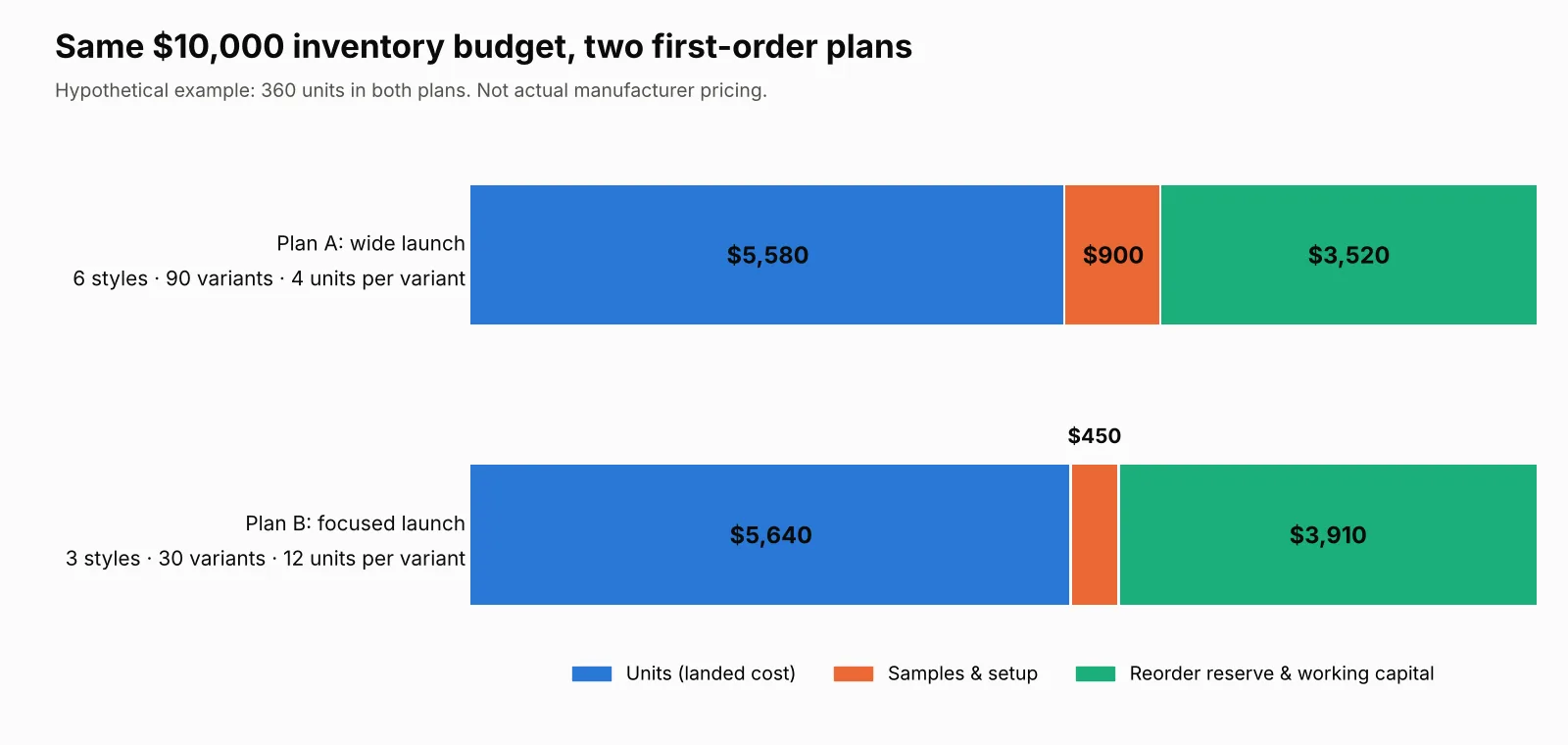
The same brand has a $10,000 inventory budget and plans 360 units. It compares two assortments. Assumed landed costs and selling prices:
| Style | Landed cost per unit | Planned selling price |
|---|---|---|
| Pullover hoodie | $24 | $70 |
| Zip hoodie | $27 | $78 |
| Leggings | $14 | $58 |
| Performance tee | $9 | $32 |
| Training shorts | $11 | $38 |
| Tank top | $8 | $28 |
Both plans include a hypothetical $150 per style for samples and branding setup.
| Plan A: wide launch | Plan B: focused launch | |
|---|---|---|
| Styles | 6 (all of the above) | 3 (pullover hoodie, leggings, performance tee) |
| Colors per style | 3 | 2 |
| Sizes per style | 5 | 5 |
| Variants | 90 | 30 |
| Units | 360 (60 per style) | 360 (120 per style) |
| Average units per variant | 4 | 12 |
| Landed cost of units | $5,580 | $5,640 |
| Samples and setup | $900 | $450 |
| Left for reorders and working capital | $3,520 | $3,910 |
Plan A spends almost the same money on units, but every variant is four units deep on average. A popular size in a popular color sells out after a handful of orders, while the slow variants still hold stock. Plan B carries three times the depth per variant, needs half the sampling budget, and keeps more cash available to reorder whatever sells first.
The wide plan is not wrong for every brand. It suits a business with strong preorder data across many styles. For a first run built on estimates, depth usually protects sales better than breadth.
Size and Color Allocation for Plan B
Plan B’s leggings run 120 units: 60 in black and 60 in navy. The size split comes from the brand’s own preorders, not a universal ratio. Fifty leggings preorders came in as XS 5, S 12, M 15, L 12 and XL 6. Scaled to 60 units per color and rounded, that becomes:
- XS: 6
- S: 14
- M: 18
- L: 14
- XL: 8
The hoodie and tee curves were built the same way from their own preorders. Hoodies follow a unisex fit, so they run S to XXL, while the tee runs XS to XL. Each curve totals 60 units per color.

Budget, Potential Revenue and Unsold-Stock Exposure
Plan B commits $5,640 to units. If every unit sold at full price, revenue would be $19,200:
- 120 hoodies × $70 = $8,400
- 120 leggings × $58 = $6,960
- 120 tees × $32 = $3,840
That is revenue, not profit. Payment fees, marketing, shipping to customers, discounts and returns all come out of it.
Now assume only 60% of every style sells during the launch window. Revenue falls to $11,520, and $2,256 of landed cost (40% of $5,640) is still sitting in stock. That is the real exposure in the plan: cash that comes back only if the remaining units sell later or at a discount. The first production run quantity should be one you could live with at that cautious sell-through, not only at the optimistic one.
Clothing Size Ratio for Inventory: How to Build Your Own
There is no reliable universal clothing size ratio for inventory. Size demand changes with your audience, fit, category and price point. Build the curve from your own signals:
- Preorders or a waitlist with size selection: the strongest signal, because customers chose a size.
- Customer surveys: useful, but people often guess their size wrong for a fit they have not tried.
- Past merchandise sales: relevant if you have sold team, gym or event apparel to the same audience.
- Your size chart and fit: a compressive legging and a relaxed hoodie can sell in different sizes to the same customer.
Colors Multiply Variants Faster Than Styles
Each added color multiplies every size of that style. Many first collections launch with one dependable core color and one accent per style, then add colors on the reorder once the first run shows what moves.
Styles and Categories Should Have Clear Jobs
Give each style a role. A hoodie can be the highest-ticket piece, leggings the repeat purchase, and a tee the lower entry price. If two styles do the same job, cut one and put the units into depth.
Inventory Budget for a Clothing Startup: Costs Beyond the Units
An inventory budget for clothing startup planning has to cover more than garments. Allocate cash in this order:
- Samples: at least one approved sample per style before bulk, plus any revisions.
- Branding setup: artwork, screens or embroidery digitizing, labels and hangtags, some of which carry their own minimums.
- The production run: units × landed cost, including freight and import charges. Duty depends on the product’s classification and can change, so confirm it with a customs broker.
- Packaging: poly bags, mailers and inserts for every unit and order.
- Storage and fulfillment: your own space or a 3PL’s receiving, storage and pick fees.
- Returns and exchanges: size swaps are common in activewear, so plan for some reverse shipping and restocking.
- Reorder reserve and working capital: the cash that lets you restock best sellers before they go out of stock for weeks.
First order budget = inventory budget − samples and setup − reorder reserve. In the worked example, that is $10,000 − $450 − $3,910 = $5,640.
Test Your Plan Against a Real Production Quote
Once you have a style list, a unit count per style and a draft size curve, a manufacturing quote turns the hypothetical landed cost into a real one. That single number changes how many units your budget buys, and with it your answer to how much inventory should I order. Best Gym Wears quotes against your planned styles and quantities, and its private label production for US activewear brands covers sampling, branding and export shipping. Send the plan before you lock the final quantities, not after.
How to Avoid Excess Inventory in a First Collection
Learning how to avoid excess inventory matters more than squeezing a lower unit price out of a bigger order. These are the risks that turn a first run into dead stock:
- Excess stock: ordering to the optimistic case when the cautious case is just as likely.
- Cash tied up in unsold product: money in slow variants cannot fund a reorder of fast ones.
- Poor size selection: a curve copied from another brand rather than built from your own buyers.
- Too many designs: each new style adds samples, setup and another set of slow sizes.
- Demand uncertainty: launch interest can fade quickly after the first week.
- Reorder delays: if replacement stock takes longer than planned, best sellers go out of stock.
- Inconsistent replenishment: a reorder that does not match the first run in fit or shade creates two versions of the same product.
Use Preorders to Replace Guesses With Orders
A preorder window answers how much inventory should I order with real orders instead of estimates, because customers commit before you do. It gives you a real size curve, collects cash before you pay for production, and tells you which styles deserve depth. The trade-off is waiting time, and some buyers will not commit without seeing the product, so many brands combine a preorder for new styles with modest stock of proven ones.
Plan the Reorder Before the First Order
Agree on a reorder point for each style, such as when the core size is half sold. Keep the approved spec, fabric and color references on file so the second run matches the first. Good activewear inventory planning treats the first order as the first of several, not a one-time bet. The same habit makes startup inventory planning easier as the range grows.
What to Prepare Before You Request a Manufacturing Quote
You are ready to ask for a quote when you can supply:
- Product styles: each garment and its fit, such as leggings, a pullover hoodie or a performance tee.
- Planned quantities: units per style and per color, with a cautious and an optimistic figure if you have them.
- Size breakdown: your size range and the curve you built from preorders or customer data.
- Branding requirements: logo files, print or embroidery positions, labels, hangtags and packaging.
- Fabric preferences: fabric type, weight and any performance needs such as stretch or moisture management.
- Destination: the country and city for delivery, and whether you use your own freight forwarder.
With those details, a manufacturer can confirm the MOQ for each style, quote a landed cost and tell you the reorder timeline, which are the three inputs that finalize your answer to how much inventory should I order.
Frequently Asked Questions
How much money do I need to start my own activewear brand?
There is no single figure, because it depends on how many styles you launch and how deep you buy. For an inventory budget for clothing startup planning, add samples and setup, the units multiplied by landed cost, and a reorder reserve. In this guide’s hypothetical plan, three styles and 360 units use $5,640 of a $10,000 inventory budget. Marketing, website and photography costs come on top of that.
How many pieces should I order for my first activewear collection?
The practical answer to how much inventory should I order is the number your evidence supports for the time until a reorder can arrive, capped by your budget and never below the supplier’s minimum per style. A small brand with an engaged email list might plan a few hundred units across two or three styles, but the right figure comes from your own audience and preorders, not a fixed rule.
How many sizes and colors should I launch with?
Launch the sizes your customers actually buy and keep colors to one or two per style. Every added color multiplies every size, so three colors across five sizes is fifteen variants for a single style. If you want extended sizes, a preorder lets you offer them without holding stock you cannot predict.
What happens if a supplier's MOQ is higher than my expected demand?
You have four realistic options: cut the number of colors or styles so each one reaches the minimum, run a preorder to prove the extra demand, ask whether colors can be mixed within the minimum, or choose a supplier with a lower MOQ for that product. Ordering the full minimum anyway is a decision to hold stock, so price that risk before you commit.
Should a new activewear brand use preorders before manufacturing?
Preorders are useful for new styles because they give you a real size curve and cash before production. They work best when customers know your product or brand already. The downside is the wait between payment and delivery, so communicate the timeline clearly and keep the preorder window short.
Which activewear products should a new brand start with?
Start with the products your audience already buys from you or asks for, and give each a clear role: a hero piece, a repeat-purchase item and an entry-price item. Leggings, a hoodie and a performance tee cover those three roles for many fitness audiences. Add categories on the reorder once sales show what your customers want.
Send Your First Collection Plan for a Production Quote
You now have the inputs that decide your first order: a demand range, a style list, a size curve and a budget split. Share your planned styles, quantities per style and color, size breakdown, branding requirements, fabric preferences and destination with Best Gym Wears, and request a production quote through the contact page. The quote gives you the confirmed costs and minimums to finalize your first activewear collection inventory before any cash is committed.