

Gym merchandise profit margins show how much of each sale your gym keeps after the product is paid for. Use the true landed cost, not the factory price: manufacturing, decoration, labels, freight and duties. Gross margin (%) = (selling price − landed cost) ÷ selling price × 100. A $55 hoodie with a $22 landed cost earns a 60% gross margin.
That 60% is a starting point, not the money in your account. Card fees, member discounts, size exchanges and hoodies still sitting on the shelf in March all come out after the gross margin is calculated. This guide walks through each layer of the math behind gym merchandise profit margins, shows where merchandise programs quietly lose money, and ends with the exact numbers you need before you ask any factory for a quote.
About the numbers in this guide: every dollar figure below is a hypothetical example built to show the math. None of it is Best Gym Wears pricing or an industry average. Replace each figure with your own quotes and sales data.
Six Numbers Behind Gym Merchandise Profitability
Most confusion about gym merchandise profitability comes from people using “margin,” “markup” and “profit” as if they meant the same thing. They measure different layers, and each one answers a different business question.
| Metric | Formula | What it tells you |
|---|---|---|
| Gross profit | Selling price − landed cost | Dollars left per unit after the product itself is paid for |
| Gross profit margin | Gross profit ÷ selling price × 100 | Share of each sale left after product cost |
| Markup | Gross profit ÷ landed cost × 100 | How far the price sits above cost |
| Contribution margin | (Price − landed cost − variable selling costs) ÷ price × 100 | What each sale contributes toward launch costs and profit |
| Net profit | Total revenue − all costs, including fixed costs and unsold stock | What the program actually earned |
| ROI | Net profit ÷ cash invested × 100 | Return on the money you put at risk |
Margin and Markup Are Not the Same Percentage
Gym apparel markup is measured against cost, and margin is measured against price. Using the example hoodie, a $22 landed cost and a $55 price give a $33 gross profit. That is a 150% markup but a 60% margin. Retail’s “keystone” rule of doubling cost is a 100% markup, which equals only a 50% gross margin.
This mix-up erodes gym merchandise profit margins at the pricing stage. If you add 60% to a $22 cost because you want a “60% margin,” you charge $35.20 and actually earn a 37.5% margin.
Why a High Markup Does Not Guarantee High Net Profit
Markup is calculated per unit sold. Net profit is calculated on everything you paid for. A 150% markup on 100 hoodies means very little if only 55 sell, because the other 45 were paid for in full. The worked example below shows exactly where that line falls.
How to Calculate a Gym Merchandise Profit Margin, Step by Step
To calculate a gym merchandise profit margin correctly, build the cost from the bottom up before you choose the price.
Step 1: Build Your Gym Merchandise Cost of Goods Sold
Your gym merchandise cost of goods sold is the landed cost of one finished, sellable unit sitting in your gym. For an imported custom hoodie, it usually includes:
- Garment manufacturing: fabric, cutting, sewing and trims, as quoted by the factory per unit.
- Decoration: screen printing, embroidery or other branding, often priced per placement.
- Labels and packaging: neck labels, hangtags and poly bags, if you order them.
- Freight: air or sea shipping, divided by the number of units in the shipment.
- Duties and import charges: customs duty, brokerage and related fees. Apparel duty depends on the product’s tariff classification and fiber content and can change, so confirm the current rate with a licensed customs broker before you finalize a price.
A common error is using the factory unit price as the cost. For overseas production, freight and duties can shift the landed cost enough to change your retail price.
Step 2: Calculate Gross Profit and Gross Margin
Gross profit (per unit) = selling price − landed cost
Gross margin (%) = (selling price − landed cost) ÷ selling price × 100
Step 3: Subtract Variable Selling Costs to Find Contribution
Some costs only happen when a unit sells, and they scale with sales:
- Card and payment processing fees, usually a percentage of the sale plus a fixed fee per transaction.
- Member or launch discounts.
- Fulfillment for online orders: shipping labels, mailers and pick-and-pack time.
- Size exchanges and replacements.
Contribution per unit = selling price − landed cost − variable selling costs
Step 4: Account for Fixed Launch Costs and Unsold Stock
Fixed launch costs happen once, whether you sell five hoodies or five hundred. Examples include artwork, embroidery digitizing, pre-production samples, product photography and a display rack. Unsold inventory is neither fixed nor variable. It is cash you already spent, and it only comes back if the stock sells.
Worked Example: Gym Merchandise Profit Margins on a 100-Hoodie Order
Here is a hypothetical program for a gym ordering 100 branded heavyweight hoodies to sell in its front-desk area and online store. All figures are illustrative.
Unit Economics for One Hoodie
| Line item | Per hoodie |
|---|---|
| Planned selling price | $55.00 |
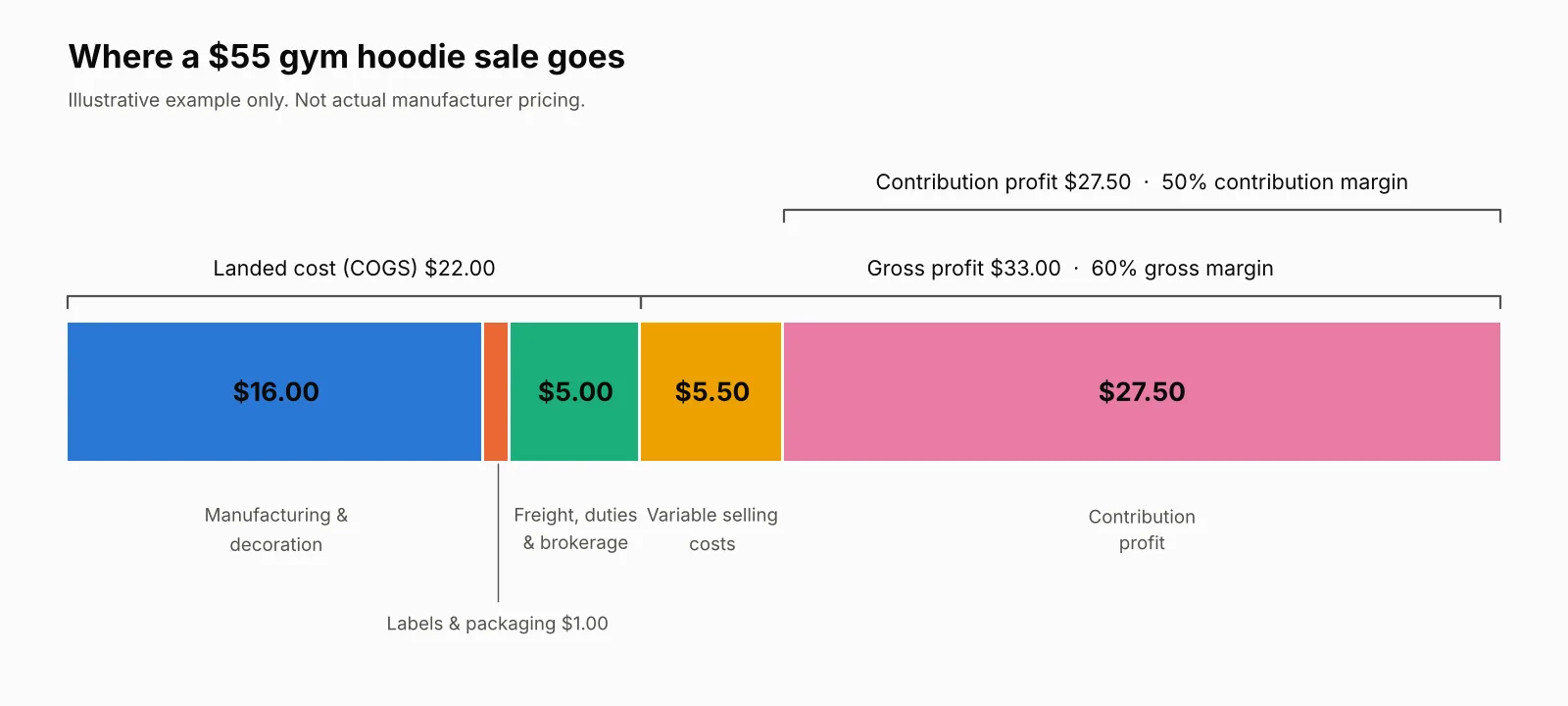
| Manufacturing and decoration (example quote) | $16.00 |
| Labels and packaging | $1.00 |
| Freight, duties and brokerage, per unit | $5.00 |
| Landed cost (COGS) | $22.00 |
| Gross profit | $33.00 (60% gross margin) |
| Payment processing (assumed 3% + $0.30) | $1.95 |
| Discount allowance (assumed 5% of price) | $2.75 |
| Fulfillment allowance (most units collected in person) | $0.80 |
| Variable selling costs | $5.50 |
| Contribution profit | $27.50 (50% contribution margin) |
The gym hoodie profit margin looks like 60% on paper. After the costs that come with every sale, each hoodie contributes $27.50, or 50% of the price.
Fixed Launch Costs and Cash at Risk
| Cash item | Amount |
|---|---|
| Artwork and embroidery digitizing | $250 |
| Pre-production sample, including courier | $200 |
| Product photos and a simple display | $150 |
| Fixed launch costs | $600 |
| Inventory: 100 hoodies × $22 landed cost | $2,200 |
| Total cash invested before the first sale | $2,800 |
Finding Your Gym Merchandise Break Even Point
Textbook break-even divides fixed costs by contribution per unit: $600 ÷ $27.50 = 21.8, so 22 hoodies. That formula assumes you only pay for hoodies when they sell, which is true for print-on-demand but not when you buy stock upfront.
When the inventory is prepaid, the realistic gym merchandise break even point compares total cash invested with what each sale brings back after variable selling costs ($55.00 − $5.50 = $49.50):
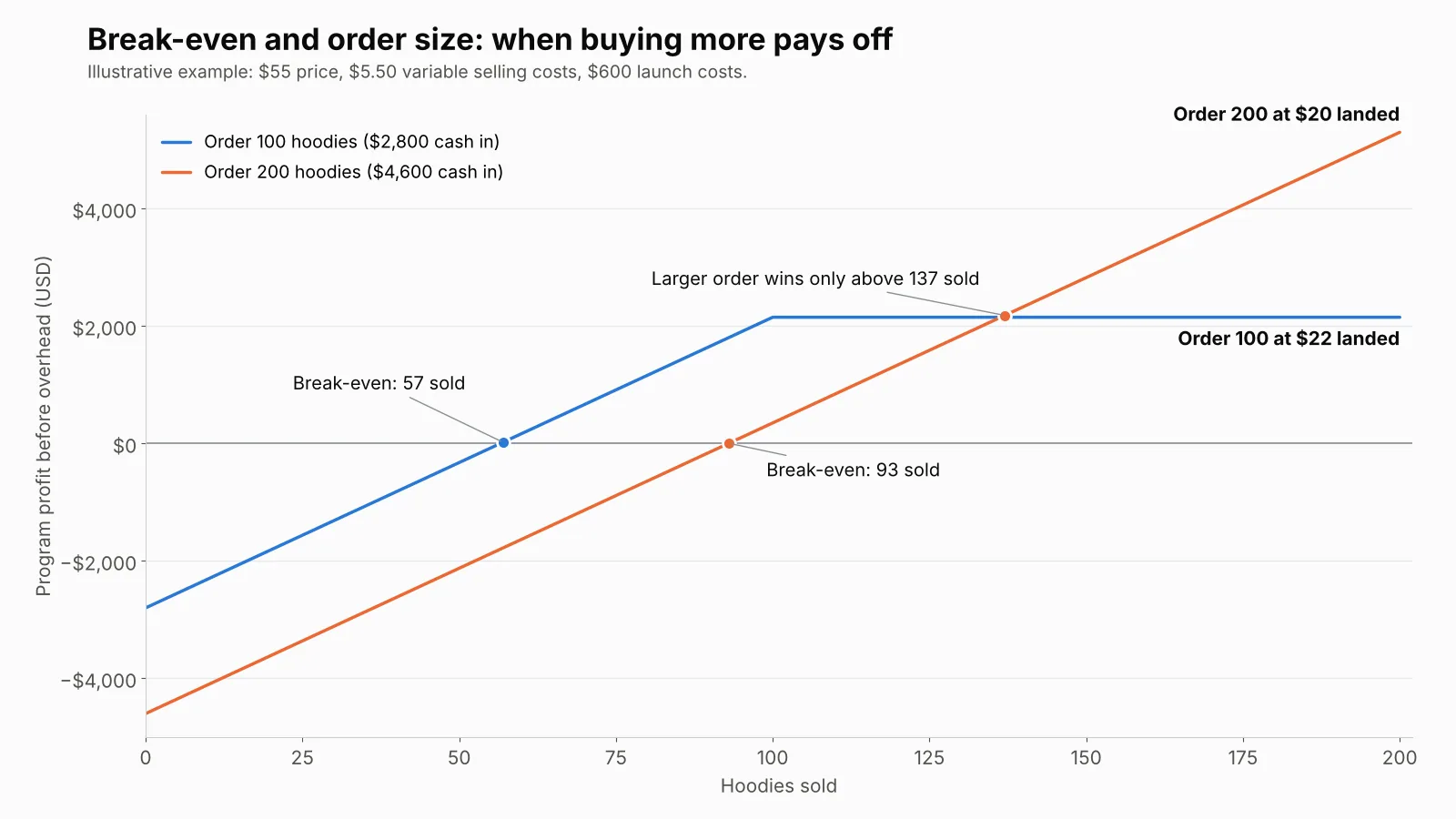
$2,800 ÷ $49.50 = 56.6, so the gym needs to sell 57 of its 100 hoodies to get its cash back.
The gap between 22 and 57 is the most expensive mistake in merchandise planning. Owners who use the textbook number believe they are profitable long before they are.
What Unsold Hoodies Do to Your Gym Merchandise ROI
The gross margin on every hoodie sold stays at 60% in each scenario below. What changes is how much of the order sells.
| Hoodies sold (of 100) | Cash returned ($49.50 each) | Program profit | ROI on $2,800 |
|---|---|---|---|
| 100 | $4,950.00 | $2,150.00 | 76.8% |
| 85 | $4,207.50 | $1,407.50 | 50.3% |
| 70 | $3,465.00 | $665.00 | 23.8% |
| 55 | $2,722.50 | −$77.50 | −2.8% |
At 70 units sold, the 70 hoodies contribute $1,925, launch costs take $600, and the 30 unsold hoodies hold $660 of cash on the shelf, leaving $665. “Program profit” here is before overhead such as staff time and storage, so your true net profit will be lower. Gym merchandise ROI depends far more on sell-through than on the margin percentage.
Hidden Costs That Shrink Gym Apparel Profit Margins
Each of these costs reduces gym apparel profit margins at a different layer. Knowing which layer helps you decide where to act.
- Manufacturing and decoration (COGS): every added print location, thread color or specialty finish raises the unit cost. Price the decoration you need, not the most elaborate version.
- Custom labels and packaging (COGS): woven labels and branded bags raise perceived value, but trims often carry their own supplier minimums, so the per-unit cost falls with quantity.
- Freight and import charges (COGS): heavier garments cost more to ship by air. Sea freight is usually cheaper per unit but takes longer, which matters if you are selling into a season.
- Payment processing (variable selling cost): small per sale, but it applies to every transaction, including discounted ones.
- Promotional discounts (variable selling cost): a 15% member discount on a $55 hoodie cuts the price to $46.75 and the gross margin from 60% to 52.9%.
- Returns and size exchanges (variable selling cost): exchanges cost staff time and sometimes shipping. A clear size chart at the counter is cheaper than a returns process.
- Fulfillment (variable selling cost): online orders add shipping and packing that in-gym sales do not.
- Unsold inventory (cash risk): the largest hidden cost in most programs. Stock in slow sizes or colors becomes cash you cannot use for your next order.
A Gym Merchandise Pricing Strategy That Protects Margin
A sound gym merchandise pricing strategy starts from the margin you need and then checks the result against what your members will pay.
Start From the Margin You Need
To hit a target gross margin, use:
Selling price = landed cost ÷ (1 − target gross margin)
At a $22 landed cost, a 60% target gives $22 ÷ 0.40 = $55. A 50% target gives $44. Choose the target only after accounting for the variable selling costs and the sell-through risk shown above.
Then Check the Price Against Your Market
The formula gives a floor, not a final price. Compare it with what your members already pay for branded hoodies, with your gym’s positioning, and with round price points members accept easily. If the formula lands above what your market will pay, change the product (fabric weight, decoration, packaging) rather than cutting the margin.
Build Discounts Into the List Price
If you plan member pricing, a launch offer or bundle deals, set the list price high enough that the discounted price still meets your margin floor. Discounting from a price that was already at your floor is how programs end up selling at break-even.
Price the Range, Not Just the Hoodie
Hoodies usually carry the highest ticket in a gym range. Tees, tanks and accessories add lower price points for members who will not spend $55. Price each item from its own landed cost, and treat a lower-margin item as a deliberate choice, such as a low-priced tee that gets your brand worn in the gym.
How to Price Gym Merchandise Around Sell-Through Risk
Knowing how to price gym merchandise is only half the decision. The order quantity sets how much cash is at risk.
Preorders Versus Buying Inventory Upfront
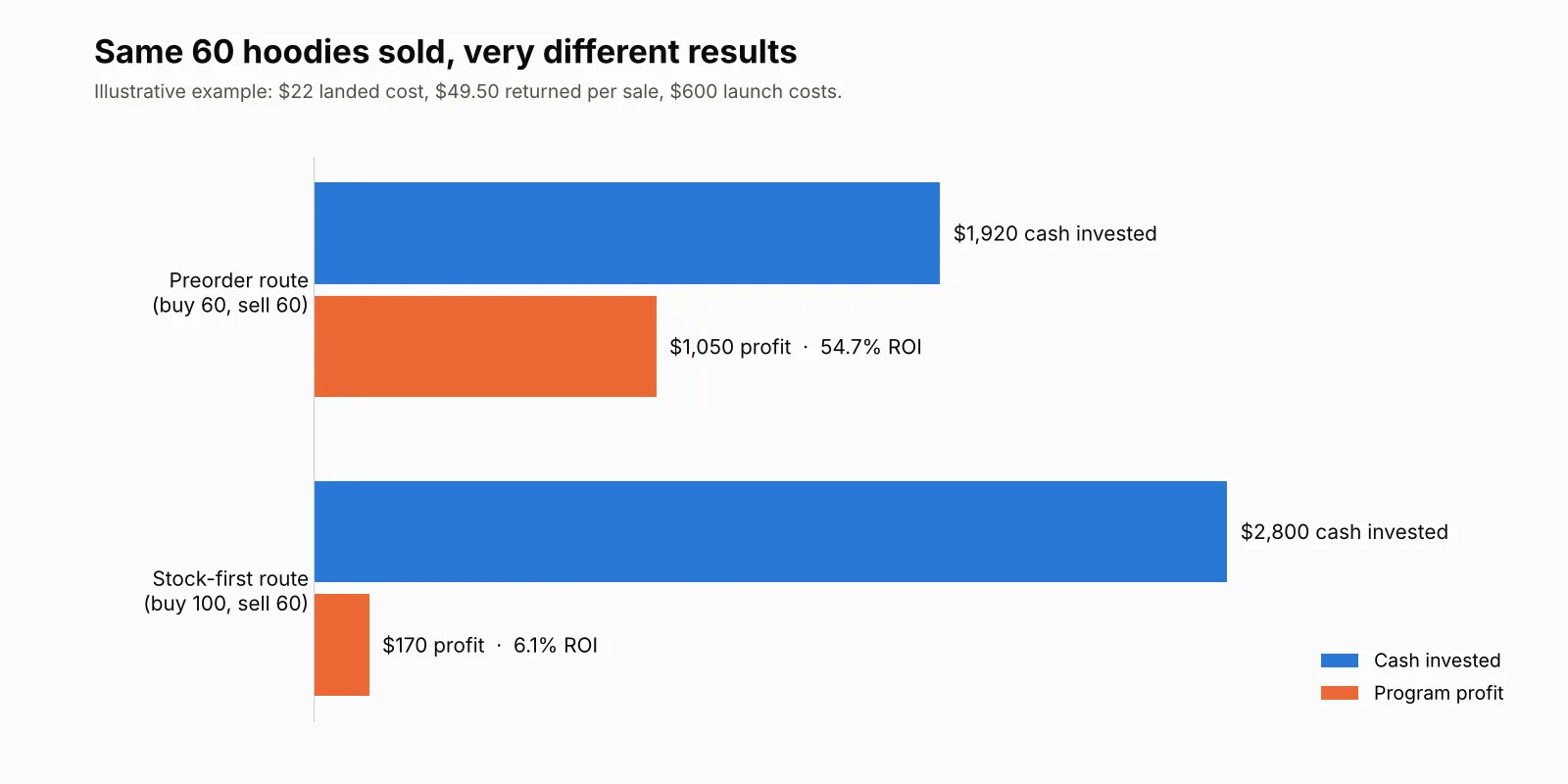
Suppose the same gym runs a two-week preorder and collects 60 orders.
- Preorder route: it buys 60 hoodies. Cash invested = $600 + (60 × $22) = $1,920. Cash returned = 60 × $49.50 = $2,970. Program profit = $1,050, a 54.7% ROI. Members pay before the factory is paid, which also helps cash flow.
- Stock-first route: it buys 100 hoodies and still sells 60. Program profit = $2,970 − $2,800 = $170, a 6.1% ROI, with 40 hoodies left to clear.
Preorders do have costs. Members wait for production and shipping, and impulse buyers who would have bought at the counter may not commit in advance. To protect gym merchandise profit margins on an untested design, many gyms use preorders for a first drop, then hold limited stock of proven sizes and colors for reorders.
When a Bigger Order Is Worth It
Larger orders usually lower the unit price, because setup is spread across more pieces. Suppose a 200-piece order brings the example landed cost down to $20. Gross margin rises to 63.6%, but cash invested rises to $4,600, and the cash break-even moves to 93 hoodies.
Compared with ordering 100 at $22, the 200-piece order only earns more if the gym would sell at least 137 hoodies. Below that, the lower unit cost is cancelled out by the extra unsold stock. Before you accept a volume discount, estimate demand honestly and calculate your own crossover point.
Plan the Reorder Before the First Order Ships
A repeat order is where merchandise programs become most profitable. Artwork, digitizing and sampling are usually already paid, so the fixed launch costs largely disappear. Ask your manufacturer to keep your approved specification, artwork and colors on file, and use the sales by size and color from the first run to set the second.
Balancing Garment Quality Against Landed Cost
A cheaper hoodie is not automatically a more profitable one. A lighter fabric or simpler finish lowers the landed cost, but it can also lower the price members will pay and the chance they will buy again. Small specification choices move the unit cost, and with it your gym merchandise profit margins: fabric weight, the number of print locations, embroidery stitch count, custom trims and packaging. The goal is the highest margin at a quality your members consider worth the price, not the lowest possible cost.
If you are comparing quotes, line them up on the same basis: the same fabric and weight, the same decoration, the same labels and packaging, and a clear statement of what is and is not included. A quote that leaves out freight or packaging looks cheaper but produces a lower margin once the goods arrive.
Test Your Profit Model With a Real Production Quote
Every number in this guide becomes useful only when the manufacturing line is real. A production quote turns your estimated landed cost into a confirmed one, and that single figure resets your price, your gym merchandise profit margins and your break-even point. Request a production quote from Best Gym Wears with your product, quantity and branding, and run the result through the calculator below before you commit to stock.
A Simple Gym Merch Profit Calculator You Can Copy
Set up this gym merch profit calculator in any spreadsheet. Enter your own figures in the first group of cells.
Inputs
- A: Selling price
- B: Manufacturing and decoration per unit
- C: Labels and packaging per unit
- D: Freight, duties and brokerage per unit
- E: Payment fee percentage
- F: Payment fee per transaction
- G: Discount allowance percentage
- H: Fulfillment and returns allowance per unit
- I: Fixed launch costs
- J: Units ordered
- K: Units you expect to sell
Outputs
- Landed cost = B + C + D
- Gross margin % = (A − landed cost) ÷ A × 100
- Variable selling costs = A × (E + G) + F + H
- Contribution per unit = A − landed cost − variable selling costs
- Cash invested = I + (J × landed cost)
- Cash break-even units = cash invested ÷ (A − variable selling costs), rounded up
- Program profit = K × (A − variable selling costs) − cash invested
- ROI % = program profit ÷ cash invested × 100
Run it three times: with your expected sales, with a cautious case, and with a strong case. If the cautious case loses money, reduce the order quantity or test demand with a preorder first.
What to Prepare Before Requesting a Manufacturing Quote
You have enough information to request a useful quote once you can answer these points:
- Product type: hoodie, tee, tank, joggers or a mix, with the style (pullover, zip, oversized).
- Estimated quantities: per style and per color, ideally with a first-order and a reorder estimate.
- Size requirements: your size range and the expected split, based on member data or past sales.
- Branding and decoration: artwork files, logo positions, method (print or embroidery) and label needs.
- Target selling price: so the quote can be checked against your margin floor before sampling.
- Quality specifications: fabric type and weight, fit, and any reference garment you want matched.
- Destination: delivery country and city, and whether you use your own freight forwarder.
With these details, a manufacturer can quote the actual cost per unit and you can calculate your real margin rather than an estimate. Gyms buying from overseas should also confirm the minimum order. At Best Gym Wears, production starts from 20 pieces per style, split across sizes, which makes it practical to test a design in a smaller run before committing to volume. You can see how the private label apparel program for US brands handles labels, sampling and export shipping.
Frequently Asked Questions
What is a good profit margin for gym merchandise?
There is no single benchmark, because published figures for gym merchandise profit margins mix gross, contribution and net margins. A more useful test is whether your gross margin still leaves a healthy contribution after card fees, discounts and returns, and whether the program pays back its full cash cost at a sell-through you can realistically achieve. In this guide’s example, a 60% gross margin becomes a 50% contribution margin.
Is a 47% profit margin good for gym apparel?
It depends which margin it is. A 47% gross margin on a $50 hoodie leaves $23.50 per unit before card fees, discounts, launch costs and unsold stock, which may be thin for a small order. A 47% net margin, after every cost, would be a strong result for most merchandise programs. Always confirm which margin a quoted figure refers to.
Is selling gym merchandise profitable for small gyms?
It can be, but profit depends mainly on sell-through, not markup. In the example above, the same hoodie at the same price produces a 76.8% return when all 100 units sell and a small loss when only 55 sell. Small gyms usually reduce risk with preorders, a narrow first range and small reorders based on actual sales.
How many hoodies does a gym need to sell to break even?
If you buy stock upfront, divide your total cash invested (launch costs plus inventory) by what each sale returns after variable selling costs. In the example, $2,800 ÷ $49.50 means 57 of 100 hoodies. The common shortcut of fixed costs ÷ contribution only works when you pay for units as they sell.
How much should a gym charge for a branded hoodie?
Start with landed cost ÷ (1 − target gross margin). At a $22 landed cost and a 60% target, the price is $55. Then check that price against what your members already pay for branded apparel, and set the list price high enough that member discounts still keep you above your margin floor.
Should a gym include staff time in merchandise costs?
For a product-level margin, no. Staff time, storage space and point-of-sale software are overheads, and they belong in the net profit calculation for the whole program. Track them separately, because a program that looks profitable per unit can still cost more in staff time than it earns if the order is too small or sales are slow.
Turn Your Merchandise Plan Into Real Numbers
Gym merchandise profit margins are decided before the first hoodie is sold: by the landed cost, the price, the order quantity and how much stock you are willing to hold. Once you have your style, quantities, branding and target price, share them with Best Gym Wears for a custom production quotation. You will get a confirmed unit cost to put into your own calculator, so you can decide whether the program meets your margin before you order.